
Table of Contents
- What Professional Flat Roofing Services Near You Should Include
- Residential and Commercial Roofing: Matching the Service to the Building
- The Commercial Roofing Contractor Checklist Every Owner Needs
- How to Run a Flat Roofing Estimate Comparison
- What Drives Flat Roof Installation Cost
- Single-Ply Membrane Roof Lifespan and Material Selection
- Repair, Replacement, and Emergency Roofing Decisions
- Conclusion
- Frequently Asked Questions
Last Updated: October 19, 2026
What Professional Flat Roofing Services Near You Should Include
Professional flat roofing services near you should include a written scope of work, a documented inspection, manufacturer-certified installation, and a warranty you can actually enforce. At United Roofing of Colorado, we have watched too many property owners learn this the hard way.
Here is the uncomfortable truth most guides skip: a flat roof rarely fails because of the membrane. It fails at the seams, the flashings, and the drains. Those three details decide whether your roof lasts five years or twenty-five.
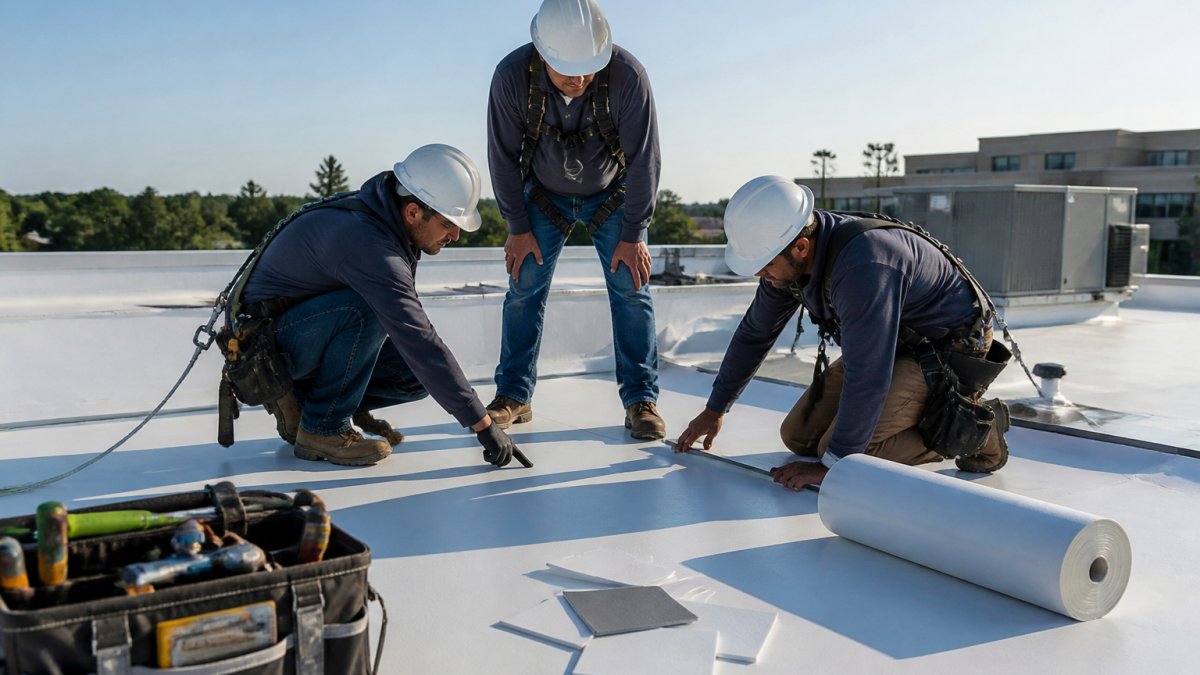
A complete service should cover:
- A core sample or moisture survey before anyone quotes a number
- Written scope listing membrane type, thickness, insulation, and fastening method
- Permit pulling and code compliance handled by the contractor
- Manufacturer certification, not just a contractor’s own promise
- Cleanup, haul-away, and a walkthrough with photos
If a bid arrives without a moisture survey, it is a guess dressed up as an estimate. Ask what happens if they open the roof and find wet insulation. The answer tells you whether you are dealing with a professional.
The most expensive mistake is hiring on price alone without a written moisture survey. Crews that skip it discover saturated insulation mid-project, then either walk off the job or bill you for a change order you never budgeted.
Residential and Commercial Roofing: Matching the Service to the Building
Residential and commercial flat roofs look identical from the street. They are not.
For homeowners in central Colorado, the priorities are snow load, ice damming, and keeping heat inside.
Commercial property owners face a different set of questions. Can the roof handle service technicians walking it every month? Will the drainage handle a fast melt after a heavy snowpack? Does the system meet the building code for occupied commercial space?
We treat these as separate disciplines. The International Code Council’s building code resources outline the structural and fire requirements that differ between occupancies, and a contractor who cannot explain those differences is not ready for your project.
Ask any contractor how many flat roofs they have completed on buildings similar to yours in the last two years. General roofers who mostly install asphalt shingles often bid flat work without the seam-welding experience it requires.
The Commercial Roofing Contractor Checklist Every Owner Needs
A commercial roofing contractor checklist should verify licensing, insurance, manufacturer certification, and local references before you sign anything. Run this list against every bidder, and you will eliminate most of the risk in one afternoon.
- Active state registration and a physical business address
- General liability and workers’ compensation certificates, current and in your name
- Manufacturer certification for the specific membrane system proposed
- Three references from commercial buildings in your area, with photos
- Written scope naming membrane thickness, insulation R-value, and fastening
- Permit responsibility stated in writing
- Warranty terms: labor, materials, and who honors each
- Payment schedule tied to milestones, not a large upfront deposit
- Lien waiver process explained before work begins
- Emergency contact and response time commitment
Two items on that list catch people out. First, insurance certificates should list you as certificate holder, not just show a policy number. Second, the warranty is often split: the manufacturer covers the membrane, the contractor covers labor. If the contractor disappears, half your coverage goes with them.
That is why we tell property owners to ask a blunt question: will you still be here in ten years? A locally owned company with a track record answers that differently than a storm-chasing crew.
How to Run a Flat Roofing Estimate Comparison
A flat roofing estimate comparison works only when every bid describes the same scope. Otherwise you are comparing a full tear-off against a recover, and the cheaper number is meaningless.
Start by writing your own scope document before you call anyone. It does not need to be technical.
The Federal Trade Commission’s guidance on home improvement contracts is worth reading before you sign anything; it explains the three-day cooling-off period for many home improvement contracts and what a contract must disclose.
| Bid Element | What to Compare | Red Flag |
|---|---|---|
| Membrane | Type, thickness, brand | “Standard membrane” with no spec |
| Insulation | R-value and thickness | Left blank or “as needed” |
| Tear-off vs. recover | Stated clearly | Vague or absent |
| Fastening | Adhered, mechanical, or ballasted | Not specified |
| Flashing details | Material and method | Lumped into a single line |
| Deck repair | Unit price per sheet if found | “Time and materials” with no cap |
| Drainage | Scuppers, drains, or retrofit scope | Omitted entirely |
| Warranty | Labor and material, separately | “Fully warranted” with no terms |
| Timeline | Start and completion dates | Open-ended |
| Payment | Milestone schedule | Large deposit upfront |
Three line items deserve their own conversation. First, ask for a unit price on deck replacement, so much per sheet of substrate, so you are not negotiating blind if rot is found.
When a bid comes in dramatically lower, ask what was excluded. The gap is usually insulation, flashing, or permit costs, and those reappear later as change orders.
Ask each contractor to break the bid into labor, materials, and disposal. A single lump-sum number hides where the money goes and makes change-order disputes harder to resolve.
Finally, compare payment schedules, not just totals. A schedule tied to milestones, materials delivered, tear-off complete, membrane installed, final walkthrough, protects you. A request for a large deposit before materials arrive is a warning sign, especially from a crew you have not worked with before.
What Drives Flat Roof Installation Cost
Flat roof installation cost depends on square footage, membrane system, insulation requirements, tear-off versus recover, and how much deck repair the project needs. No honest contractor quotes a number before seeing the roof.
The U.S. Department of Energy’s guidance on roof insulation and cool roofs explains how insulation levels affect energy performance, which is one reason two identical buildings can carry very different price tags.
Factors that move the number:
- Roof area and access. Tight urban lots and steep parapets slow crews down.
- Tear-off. Removing existing layers adds disposal and labor.
- Deck condition. Rotted substrate has to be replaced before anything goes down.
- Insulation. Higher R-values cost more upfront and pay back in energy savings.
- Penetrations. HVAC curbs, skylights, and vents each need detailed flashing.
- Drainage. Adding scuppers or retrofitting drains is real work.
- Season. Winter and high-altitude scheduling affects labor availability.
We quote every project after an on-site inspection because a phone estimate is a fiction. Request a free roofing estimate and you will get a written scope, not a guess.
Single-Ply Membrane Roof Lifespan and Material Selection
Single-ply membrane roof lifespan runs roughly 15 to 30 years depending on material, thickness, installation quality, and maintenance. The membrane is only part of the equation; seam quality and flashing detail decide whether you reach the upper end.
Three single-ply families dominate flat roofing:
- PVC (polyvinyl chloride). Heat-welded seams, strong chemical resistance, well suited to commercial kitchens and buildings with grease exhaust.
- TPO (thermoplastic polyolefin). Heat-welded, reflective, widely used on commercial roofs with good energy performance.
- EPDM (ethylene propylene diene monomer). Rubber membrane, adhered or ballasted, proven in cold climates.
Duro-Last is a PVC-based system with factory-fabricated components, which means fewer field seams and less room for installation error. That matters at altitude, where wind uplift and freeze-thaw cycles punish every weak detail.
Material selection should follow building use, not marketing. Kitchens and restaurants lean PVC, large reflective commercial roofs lean TPO, and cold-climate retrofits often favor EPDM or a fabricated PVC system. Ask why a contractor recommends a specific membrane and listen for building-specific reasons.
Repair, Replacement, and Emergency Roofing Decisions
Repair beats replacement when the damage is isolated and the membrane has life left. Replacement wins when leaks recur across multiple areas or the insulation is saturated.
Use a simple decision framework before you authorize anything:
- One leak, one location, membrane under 10 years old. Repair is usually the right call. Get photos of the failure, a written scope for the patch, and a warranty on the repair itself.
- Two or more leaks in different areas within 12 months. The membrane is telling you it is near the end of its service life. Start planning replacement rather than paying for repairs that will not stop.
- Soft spots or spongy decking underfoot. Saturated insulation or rotted substrate is present. A patch will not fix it; the wet material has to come out.
- Ponding water that lingers more than 48 hours after rain. Drainage is undersized or blocked. Sometimes the fix is clearing drains and adding scuppers; sometimes it signals structural deflection that needs evaluation.
- Interior staining that spreads after every storm. Water is traveling along the deck, not just through one seam. The source is rarely where the stain appears.
Roof leaks rarely announce themselves at a convenient time. A small seam failure can soak insulation for weeks before it shows up on your ceiling, and by then the repair scope has grown.
If you do have an active leak, the emergency response should follow a sequence. First, stop the water from spreading inside, buckets, tarps, and moving equipment are on you. Second, document everything with photos and notes, because your insurer will ask.
Never authorize an emergency repair without photos of the damage and a written scope. Storm-chasing crews collect deposits and vanish, and the homeowner is left with an open roof and no recourse. Ask for the contractor’s state registration number and insurance certificate before anyone gets on the roof.
Re-roofing decisions should weigh remaining membrane life against the cost of repeated repairs. A rough rule of thumb: if repair spending over two years approaches a meaningful fraction of replacement cost, replacement is the better financial decision. Get a written replacement estimate and compare it against your repair history, not against a feeling.
Our customers describe the difference.
Conclusion
Flat roofing rewards the property owner who asks hard questions before signing, not the one who picks the lowest bid. Get the moisture survey, compare scopes line by line, verify the certification, and read the warranty terms.
United Roofing of Colorado is a locally owned, certified Duro-Last installer with over 30 years of combined industry experience, serving homeowners and commercial property owners across central Colorado. We handle insulation, gutters, skylights, and full membrane systems with prompt scheduling and clear communication. Request your free roofing estimate and get a written scope built around your building, not a template.
Frequently Asked Questions
What should I look for when hiring a flat roofing contractor?
Start with licensing, insurance, and manufacturer certifications. A certified installer for systems like Duro-Last can offer stronger warranties than a general roofer. Ask for local references, photos of completed flat roof projects, and written proof of liability and workers’ comp coverage. Confirm the crew has specific low-slope experience, since flat roofing demands different drainage and membrane skills than shingle work. Finally, get a written scope that names materials, thickness, and warranty terms, not just a lump-sum number.
How can I compare flat roofing estimates fairly?
Line up estimates side by side and check that each one covers the same scope: tear-off versus overlay, insulation thickness, membrane type, flashing, drainage, and permits. A lower bid often excludes deck repair or uses a thinner membrane. Ask each contractor to itemize labor, materials, and disposal. Compare warranty length and whether it is manufacturer-backed or contractor-only. A flat roofing estimate comparison should weigh total value, not just the bottom line, and any quote that skips a roof inspection first deserves extra scrutiny.
How long do single-ply membrane roofs last?
Single-ply membrane roof lifespan varies by material and installation quality. Thermoplastic membranes like Duro-Last are commonly rated for decades when installed by certified crews over sound decking, while EPDM and PVC systems carry their own manufacturer warranties. High-altitude snow, wind, and freeze-thaw cycles shorten life if drainage and flashing are poor. Regular inspections and prompt leak repair extend any membrane’s service life. Ask the contractor for the specific warranty term in writing rather than a general estimate.
How much does a flat roof installation cost?
Flat roof installation cost depends on square footage, membrane type, insulation, deck condition, drainage work, and access. Pricing also reflects whether the job is a tear-off or an overlay and whether permits are required. Because every building differs, reputable contractors inspect first and quote in writing. Rather than rely on a generic per-square-foot figure, request a free estimate that itemizes materials, labor, and warranty so you can compare bids on equal terms.