
Last Updated: November 15, 2026
Quick Summary
Preventing roof failure in winter means keeping warm air out of the attic, clearing snow safely from the ground, and managing drainage before the first freeze. Seal attic bypasses, keep soffit vents open, and clear gutters, downspouts, and flat-roof drains so meltwater cannot pool and refreeze. Watch for a sagging roofline, spreading water stains, or ice that returns in one spot, and call a certified professional.
- Ice dams form when heat escapes the attic, melts snow, and the water refreezes at the cold roof edge.
- Use a roof rake from the ground and never climb a snowy roof, since most winter roof injuries are falls.
- A sagging roofline is the clearest sign of roof failure and warrants an immediate professional call.
- A blocked flat-roof drain turns the whole roof into a shallow pond that stresses seams.
- Snow guards on metal roofs break sliding snow into manageable pieces before it releases below.
Table of Contents
- Why Winter Pushes Flat and Low-Slope Roofs to the Breaking Point
- How to Prevent Ice Dams on Flat Roofs Before They Start
- Roof Snow Removal Safety Tips for Homeowners and Facility Managers
- Signs of Roof Structural Stress You Should Never Ignore
- Gutter, Downspout, and Drainage Management That Protects the Deck
- Material-Specific Winter Care: Membrane, Metal, and Shingle Roofs
- Insurance, Liability, and When to Call a Certified Professional
- Schedule Your Free Winter Roof Inspection
- Frequently Asked Questions
Why Winter Pushes Flat and Low-Slope Roofs to the Breaking Point
Preventing roof failure in winter starts with understanding what snow and ice actually do to a flat or low-slope roof. Snow load is the weight of accumulated snow pressing on the deck.
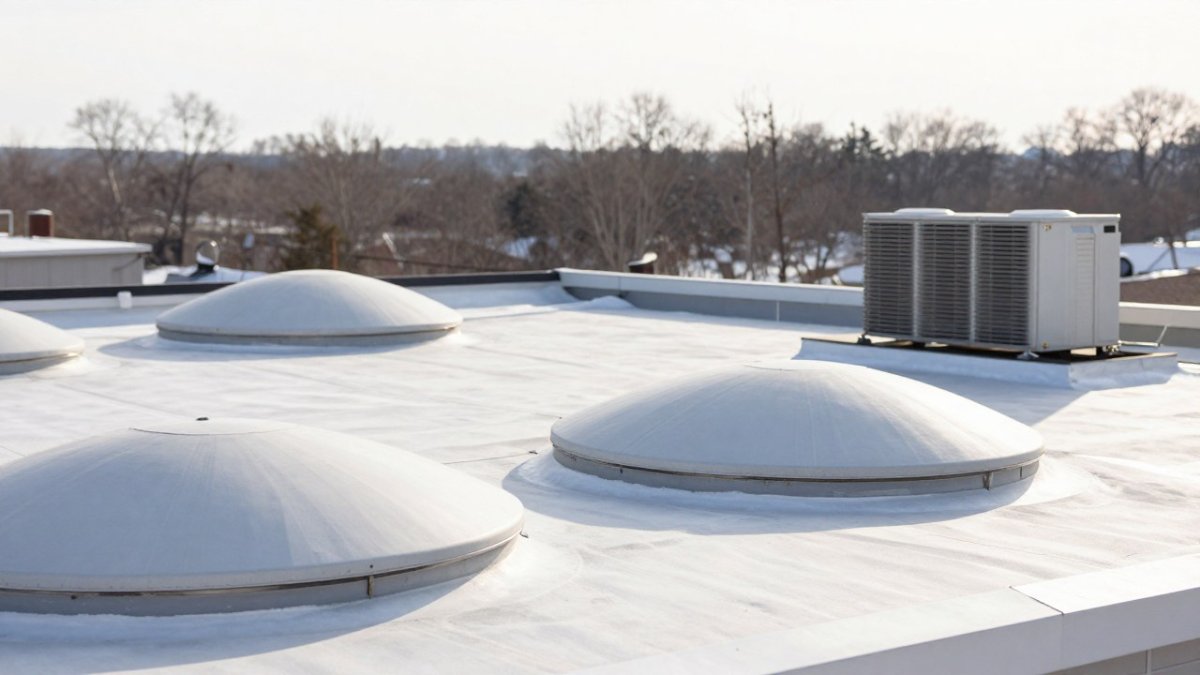
Ice makes it worse. Water from melting snow refreezes at the roof edge and backs up under the membrane. For the deeper causes and fixes, see why flat roofs leak.
Below, we walk through the steps that help stop that cycle before it starts.
Thermal bridging matters too. Wood framing conducts cold straight through the insulation, so those spots stay cold and collect frost. That frost melts, refreezes, and feeds the ice problem. Flat roofs have little pitch to drain it away.
How to Prevent Ice Dams on Flat Roofs Before They Start
To prevent ice dams on a flat roof, keep warm air out of the attic and keep meltwater moving off the deck. Ice dams form when heat escapes upward, melts snow, and the water refreezes at the cold edge.
Two fixes do most of the work:
- Seal attic bypasses, the gaps around pipes, vents, and light fixtures
- Add weatherstripping to the attic hatch so warm air stays in the house
- Keep soffit vents open so cold air can move under the deck
Attic Insulation, Ventilation, and Thermal Bridging
Insulation R-value and attic ventilation decide whether your roof stays cold on top. A cold roof holds snow evenly. A warm roof melts from below and refreezes at the edges.
Check that insulation covers the joists evenly and does not block soffit vents. Where framing runs cold, add a thermal barrier.
Roof Snow Removal Safety Tips for Homeowners and Facility Managers
Use a roof rake from the ground. Never climb a snowy roof. Most winter roof injuries are falls, not collapses, and a wet, cold roof deck gives you no grip. The physics are unforgiving: a frozen shingle or membrane surface has almost no coefficient of friction, and a fall from even a single-story eave can cause serious injury.
Snow removal safety comes down to a few rules:
- Stay on the ground and pull snow down, never push it
- Keep ladders off icy gutters
- Work with a spotter and clear a safe path first
- Remove snow in stages, not all at once
- Never use a metal shovel or an axe on the roof surface
- Keep the rake head away from overhead power lines
Safety Equipment Checklist
- Roof rake with an extendable handle (reach the lower third of the roof without a ladder)
- Insulated, non-slip boots with aggressive tread
- Safety glasses and cut-resistant gloves
- A spotter on the ground who can call for help
- A cleared path with no cords or tools underfoot
- A hard hat if you must work near the eave or under an overhang
- A fall-arrest harness and anchored lifeline only if a professional determines roof access is unavoidable
The DIY vs. Professional Decision, and the Liability Behind It
Most homeowners can safely clear the lowest few feet of snow with a roof rake. The calculus changes when the snow depth exceeds what a rake can reach, when ice has bonded to the surface, or when the roof is steep, tall, or already showing stress.
Ask any roofing contractor for proof of insurance before work begins, and keep a dated record of inspections or removal you perform. Check your own policy terms with your insurer, since coverage varies.
Facility managers should close off walkways below before any roof work, post barricades at building entrances, and check the load-bearing capacity of the deck with a structural professional before sending anyone up.
Signs of Roof Structural Stress You Should Never Ignore
The clearest sign of roof failure is a sagging roofline. If the deck dips, the membrane ripples, or a door suddenly sticks, stop and call a professional.
Other warning signs:
- New cracks in interior walls or ceilings
- Water stains spreading after a melt
- Popped fasteners or lifted seams
- Ice buildup that keeps returning in one spot
- A soft or spongy feel at the roof edge
A common mistake is patching the leak and ignoring the sag. The water is a symptom. The structure is the problem. If you spot these signs, read our guide to the 7 flat roof repair mistakes Colorado owners make before you authorize any work.
Gutter, Downspout, and Drainage Management That Protects the Deck
Clear gutters and downspouts before the first freeze. Drainage management is what carries meltwater off the roof instead of letting it pool and refreeze.
On a flat roof, check the internal drains and scuppers. A blocked drain turns the whole roof into a shallow pond. Water then finds every seam and flashing gap.
- Clear leaves and debris from gutters and downspouts
- Check drain strainers and clear them by hand
- Confirm downspouts discharge away from the foundation
- Look for ponding water after a melt
Flashing around vents and skylights is the next weak point. Lift the edge, check the seal, and reseal before winter.
Material-Specific Winter Care: Membrane, Metal, and Shingle Roofs
Each roof material fails in its own way, so winter care should match the surface. Generic advice, clear the snow, check the gutters, misses the failure mode that actually ends a given roof’s winter. The table below is a starting point; the notes after it explain what to look for and why.
| Material | Winter Weak Point | What to Check |
|---|---|---|
| Single-ply membrane | Seam lift, ponding | Welded seams, drains, pipe boots |
| Metal | Fastener back-out, snow slides | Screws, snow guards, panel laps |
| Shingle | Cracking, ice damming | Flashing, attic heat, granule loss |
| Modified bitumen | Cracking at cold bends | Surface cracks, edges, lap seams |
Single-Ply Membrane (TPO and PVC)
A single-ply membrane has continuous sheets and seams that are heat-welded. The weak points are the seams and the penetrations. Cold makes the membrane less pliable, so a seam that was marginal in October can open when the sheet contracts. Before the snow arrives, check every welded seam by hand for lift or a cold weld, and inspect pipe boots and drain rings for cracking. Ponding is the other risk: a blocked drain turns the roof into a shallow pool, and repeated freeze-thaw at the water line stresses the membrane. After a melt, look for standing water that has not drained within 48 hours.
Metal Roofs
Metal roofs shed snow quickly, which can release snow onto areas below. The same slick surface that clears itself can release a sheet of snow onto a walkway, a car, or a lower roof. Snow guards, small brackets clamped or screwed to the panels, break the slide into manageable pieces. Fasteners are the other weak point: thermal movement works screws loose over time, and a backed-out fastener is a leak path. Check exposed fasteners for backing out and confirm panel laps are still engaged. On standing-seam metal, inspect the seam clips and the sealant at the ridge and eave.
Asphalt Shingles
Shingles become brittle in deep cold, so foot traffic and ice movement crack them. The bigger winter problem is ice damming, which is an attic-heat issue as much as a roof issue. Check the flashing at chimneys, skylights, and valleys, and confirm the attic insulation and ventilation are keeping the deck cold. Granule loss in the gutters after a melt is a sign the shingles are aging and less able to shed water. Watch out: walking a frozen shingle roof to clear snow often does more damage than the snow itself, so stay on the ground.
Modified Bitumen
Modified bitumen is a tough, layered membrane, but it cracks at cold bends and at the edges where it is most exposed. Inspect the surface for hairline cracks, check the lap seams, and look at the terminations at walls and drains. A cold-bend crack that is sealed before winter will not grow into a leak; one that is ignored will.
The common thread across all four materials is that winter care is really pre-winter care: the inspection you do in the fall determines how the roof performs in the cold.
Insurance, Liability, and When to Call a Certified Professional
Call a certified professional when you see sagging, spreading water stains, or ice that returns every year in the same spot. Those point to structural stress, not a simple patch.
Insurance and liability deserve a hard look before winter. Many policies cover sudden damage but not neglect. A documented preventative inspection helps your claim and protects you if snow from your roof damages a neighbor’s property.
Ask for proof of insurance and a written warranty. Our guide on how to choose a commercial roofing company covers the questions to ask, and our overview of finding reliable roofing warranty coverage explains what to confirm before you sign. If you are ready to hire, see our guide to flat roof repair near me.
Schedule Your Free Winter Roof Inspection
Winter does not wait, and neither should your roof. A free inspection can help identify small seam, drain, or attic issues before they grow.
United Roofing of Colorado is a locally owned and operated business specializing in professional Duro-Last roof installations for both residential and commercial properties, with over 30 years of combined industry experience. Get started with United Roofing of Colorado by requesting a free roofing estimate.
Frequently Asked Questions
How many inches of snow can a roof hold before it collapses?
There is no single number, because load-bearing capacity depends on the roof’s design, age, and span. Most residential roofs are designed to support a limited snow load, and wet, dense snow carries far more weight than light, dry snow. Flat roofs with ponding water or existing moisture intrusion carry less margin. Watch for sagging, cracks, or doors that suddenly stick, and call a professional before those signs worsen.
What are the most effective ways to prevent ice dams on a flat roof?
Start with the attic: seal bypasses, add insulation to the recommended R-value, and confirm soffit vents and exhaust fans move air properly so the roof deck stays cold. Clear gutters and downspouts before the first freeze so meltwater has somewhere to go. On flat and low-slope roofs, check that drains and scuppers are open and that flashing around penetrations is sealed. If ice buildup has already formed, do not chip at it; call a roofer who can address the source rather than the symptom.
Should I shovel my roof after a heavy snowfall?
Only if you can do it safely from the ground with a roof rake, and only on a roof you can reach without a ladder. Never walk a snow-covered flat roof: you cannot see skylights, vents, or thin deck sections under the snow, and a fall from height is the leading serious injury in roof snow removal. If accumulation is deep, wet, or you see signs of structural stress, hire a professional. Prevention is generally more effective than cleanup after damage has occurred.
What temperature is too cold to replace a roof?
For shingles and most adhesives, sustained temperatures below about 40°F can prevent proper sealing and make materials brittle. Membrane roofing systems are installed with different methods than adhered roofing, and your contractor can explain how their system performs in freezing conditions. Ask your contractor which system they are using and how it performs in freezing conditions before scheduling work in winter.
