
Last Updated: October 25, 2026
Quick Summary
The best roofing for mountain regions is standing-seam metal, because raised seams let snow slide off in sheets and keep weight off the structure. Metal also lasts long, with one case study describing a metal roof that endured Canadian winters for over 40 years. Asphalt shingles only work on lower-slope roofs with strong underlayment and good ventilation.
- Roughly 80% of roofing projects use asphalt shingles, but that material is not always the smart pick at high elevation.
- A steeper roof pitch sheds snow faster and reduces the structural load on the frame.
- Ice dam prevention needs an ice-and-water barrier at the eaves, continuous underlayment, roof ventilation, and sealed flashing.
- Place snow guards above every entryway, walkway, parking spot, and HVAC unit to control where snow lands.
- Compare bids on cost per year of service, and confirm your jurisdiction’s ground snow load and fire classification in writing.
Table of Contents
- Roofing Materials for Snowy Winters: What Holds Up and What Fails
- Metal Roofing for Snow: Why Standing-Seam Panels Lead in Mountain Climates
- Asphalt Shingles in Mountain Regions: Where They Work and Where They Don’t
- Steep-Slope Roofing for Mountain Homes: Pitch, Snow Shedding, and Structural Load
- Ice Dam Prevention for Mountain Roofs: Underlayment, Ventilation, and Flashing
- Snow Guards, Entryways, and Controlled Snow Shedding
- Cost, Lifespan, and Local Codes: Comparing Long-Term Value
- Getting a Free Roofing Estimate for Your Mountain Home
- Frequently Asked Questions
Roofing Materials for Snowy Winters: What Holds Up and What Fails
Finding the best roofing for mountain regions starts with one hard truth: roughly 80% of roofing projects use asphalt shingles, according to RubyHome’s roofing statistics, yet that same material is not always the smart pick at high elevation. Snow sits longer. Ice refreezes. UV light at altitude is brutal. A roof that performs fine at lower elevation can fail fast up here.
An average roof lasts 20 to 50 years, per the same RubyHome data, but that range assumes the material matches the climate. Mountain homes face a tougher test:
- Heavy snow loads that stress the deck
- Freeze-thaw cycles that pry at seams
- Rapid temperature swings between sun and shade
- Wind that drives snow into every gap
So which materials actually hold up? Here is the short version before we break each one down.
| Material | Snow Shedding | Lifespan | Best For |
|---|---|---|---|
| Standing-seam metal | Excellent | Long | Steep roofs, heavy snow |
| Asphalt shingles | Fair | Moderate | Budget builds, lower pitch |
| Slate | Good | Very long | High-end, high-slope homes |
| Wood shakes | Fair | Moderate | Rustic looks, mild loads |
The best roofing for mountain regions is a system, not just a surface. Keep reading, because the layers under the material matter as much as the material itself.
Metal Roofing for Snow: Why Standing-Seam Panels Lead in Mountain Climates
Metal roofing for snow has become the top choice for many mountain homes, and standing-seam panels earn that spot for one simple reason: snow slides off. A comparison from Rebar & Lumber on mountain roofing materials notes that standing-seam and corrugated panels shed snow well, which keeps weight off the structure.
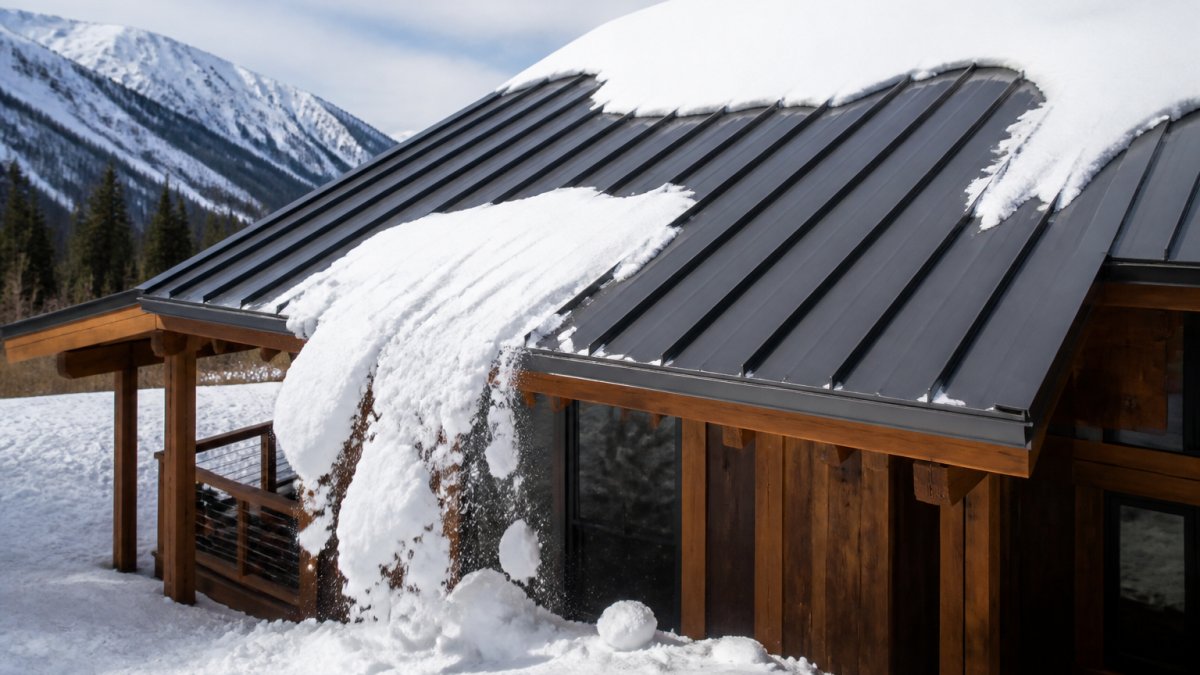
Standing-seam panels have raised seams that let snow release in sheets. That is great for the roof. It is less great for whatever sits below.
Durability backs up the performance. A DECRA case study on metal roofs in harsh winters describes a metal roof that endured Canadian winters for over 40 years. That is the kind of long-term performance mountain owners want.
The trade-offs are real, though:
- Higher upfront cost than asphalt
- Snow dumps fast, so you need guards near walkways
- Installation quality decides everything
What most guides miss is that metal only wins when the framing and fasteners match the panel. Weak attachment turns a great panel into a liability.
Asphalt Shingles in Mountain Regions: Where They Work and Where They Don’t
Asphalt shingles work in mountain regions on lower-slope roofs with strong underlayment and good ventilation. They fail on steep, snow-heavy roofs where ice dams form and granules wear off fast. The 80% market share from RubyHome makes sense for cost, but popularity is not the same as suitability.
Architectural shingles, also called laminated shingles, beat three-tab shingles on wind resistance and thickness. That matters when winter storms roll through. Still, shingles hold snow longer than metal, and trapped snow leads to ice buildup at the eaves.
Here is where they make sense:
- Budget-friendly builds where upfront cost rules
- Lower-pitch roofs that shed snow slowly anyway
- Homes with solid attic ventilation already in place
And where they don’t:
- Steep roofs that dump snow onto doorways
- Homes above tree line with constant wind
- Any roof with a history of ice dams
If you are weighing shingles against metal, be honest about your pitch and snow load. That decision drives everything else.
Steep-Slope Roofing for Mountain Homes: Pitch, Snow Shedding, and Structural Load
Steep-slope roofing for mountain homes is less about looks and more about physics. A steeper roof pitch sheds snow faster and reduces the structural load on the frame, but pitch alone does not decide performance.
Start with the load. Guidance from Read Metal Roofing on mountainous regions recommends confirming local ground-snow-load requirements and specifying stronger framing members before you pick a material.
Pitch changes how much snow the structure actually carries. As a rule of thumb, steeper roofs shed faster and hold less; lower pitches hold more and rely more on the underlayment and ice-and-water barrier to survive.
| Roof pitch | Metal | Asphalt shingles | Slate |
|---|---|---|---|
| Steep (8:12 and up) | Fast shedding, low load, needs snow guards | Moderate shedding, watch the eaves | Good shedding, very heavy |
| Medium (4:12-8:12) | Good shedding, guards advised | Slow shedding, ice-dam risk | Good shedding, heavy |
| Low (below 4:12) | Sheds slowly, plan for ice | Not recommended without special assembly | Not typical |
Roof shape matters as much as pitch. Valleys, dormers, and changes in plane collect snow and create the freeze-thaw pockets where ice dams form.
Structural capacity is the constraint most homeowners miss. Slate can weigh several times what asphalt does, and a roof framed for shingles may not carry it without reinforcement.
A steep metal roof sheds snow almost too well. Without snow guards above entryways and walkways, that shedding becomes a hazard. Pitch and material choices should be made together with guard placement, not after.
Get the pitch, shape, and framing right, and the material becomes an easier call. Get them wrong, and the best panel on the market still underperforms.
Ice Dam Prevention for Mountain Roofs: Underlayment, Ventilation, and Flashing
Ice dam prevention for mountain roofs comes down to three layers working together: a proper ice-and-water barrier, steady roof ventilation, and sealed flashing. Skip any one and meltwater finds a way in. Water infiltration is a common cause of mountain roof damage.
The system under the surface does the quiet work:
- Ice-and-water barrier at the eaves stops water backing up under shingles
- Continuous underlayment covers the whole deck, not just the edges
- Roof ventilation keeps the attic cold so snow melts evenly
- Flashing seals valleys, chimneys, and wall joints
Freeze-thaw cycles are the enemy here. Snow melts, refreezes at the cold eaves, and dams up. Then water pushes under the shingles. A warm attic makes it worse by melting snow from below.
Watch out: a roof with great shingles and no ice-and-water barrier will still leak at the eaves. The visible material gets all the attention. The layers you never see prevent the damage.
Snow Guards, Entryways, and Controlled Snow Shedding
Snow guards control where snow lands, and that is a safety issue, not a cosmetic one. Metal roofs shed snow in big sheets. Without guards, that snow lands on walkways, driveways, and doorways. People get hurt.
Where to place guards:
- Above every entryway and door
- Over walkways and parking spots
- Around HVAC units and vents
- Above lower roof sections
Snow shedding is a feature, but only when it is controlled. Guard placement should be planned around how you actually use the space below.
This is the detail most guides skip. A roof that sheds perfectly can still be a hazard if nobody thought about where the snow goes.
Cost, Lifespan, and Local Codes: Comparing Long-Term Value
Cost, lifespan, and local codes decide long-term value more than any single material, and most guides wave at that idea without putting numbers on it. Here is the transparent version.
| Material | Typical installed cost per square (100 sq ft) | Expected service life | Cost per year of service |
|---|---|---|---|
| Architectural asphalt shingles | $400-$700 | 20-30 years | ~$15-$35 |
| Standing-seam metal | $900-$1,600 | 40-70 years | ~$15-$40 |
| Slate | $1,500-$3,000+ | 75-100+ years | ~$15-$40 |
| Wood shakes | $600-$1,100 | 25-40 years | ~$20-$45 |
Those ranges come from common contractor pricing patterns, not a single published study, so confirm them against local bids. The point is the last column: sticker price and cost per year of service tell different stories.
Maintenance is the hidden line item. Metal needs little beyond checking fasteners and flashing after severe storms. Asphalt shingles need periodic inspection after winters, and granule loss on sun-facing slopes at altitude shortens life faster than the label suggests.
Local codes are not optional. Mountain jurisdictions commonly set ground snow-load requirements that drive framing and sheathing specs, and many adopt the International Residential Code (IRC) with local amendments. Fire ratings matter too: Class A assemblies are widely required, and in wildfire-prone areas insurers and codes may push toward metal or other noncombustible coverings. Verify three things before you buy:
- The design ground snow load your jurisdiction requires
- The fire classification your assembly must meet
- Whether your insurer offers a premium credit for impact- or fire-rated materials
A cheap roof that fails inspection or voids coverage costs more than the upgrade. Compare bids on cost per year of service, confirm the code requirements in writing, and ask your carrier about credits before you sign. You can also take a look at our completed projects to judge work quality before committing.
The real number to compare is cost per year of service, not the sticker price, and the code and insurance requirements in your jurisdiction can override the material math entirely.
Getting a Free Roofing Estimate for Your Mountain Home
Getting a free roofing estimate for your mountain home is the right next step once you know your pitch, snow load, and material options. Guessing wastes money. A site visit confirms what your roof actually needs.
We install Duro-Last membrane systems and handle repairs, patching, and full replacements. Our team is locally owned, certified by Duro-Last, and brings over 30 years of combined industry experience to every job. We schedule around you and keep communication clear from quote to cleanup.
Two ways to move forward:
- Request a free roofing estimate for your mountain property
- Contact our team with questions or to schedule service
Do not wait for the next leak to force the decision. Get the assessment while the weather is on your side.
Frequently Asked Questions
What is the best roofing material for a mountain climate?
Standing-seam metal is often the top choice for mountain roofing because its smooth surface sheds snow and resists freeze-thaw cycles. Asphalt shingles remain common and cost less upfront, but they can lose granules and crack in extreme cold. Slate lasts decades and handles temperature swings, though its weight requires structural reinforcement. The right pick depends on your roof pitch, snow load, and budget.
How do you prevent ice dams on a mountain roof?
Ice dam prevention for mountain roofs starts with a continuous ice-and-water barrier under the shingles or panels, paired with proper attic ventilation and insulation to keep the roof deck cold. Extend drip edges and ensure flashing is sealed at valleys and penetrations. In heavy snow regions, a roof rake can remove the bottom few feet of snow after storms, reducing the meltwater that refreezes at the eaves.
Is a metal roof a good choice for a mountain home?
Metal roofing for snow performs well in mountain regions because standing-seam panels shed accumulation and resist wind uplift. Metal also handles freeze-thaw cycles without cracking. The biggest drawbacks are higher upfront cost and noise during rain or hail. Snow guards are essential above entryways and walkways to control sliding snow. With correct installation and underlayment, metal delivers long-term performance in extreme weather.
What roof pitch is best for snowy mountain regions?
Steep-slope roofing for mountain homes typically starts at a 6:12 pitch or steeper to encourage snow shedding. A 9:12 or greater pitch improves sliding on metal roofs, but very steep pitches can make installation and maintenance harder. Check local ground-snow-load requirements and confirm your framing can carry the weight. Low-slope roofs need different systems, such as membrane roofing, to manage water infiltration.
Mountain roofing rewards planning and punishes shortcuts. The best roofing for mountain regions pairs the right material with the right pitch, framing, and hidden layers. United Roofing of Colorado can help you get that combination right, with certified Duro-Last installation, prompt service, and convenient scheduling built around your timeline. Get started with United Roofing of Colorado and protect your home before the snow returns.
