
Last Updated: October 26, 2026
Quick Summary
Duro-Last roofing is a thermoplastic single-ply membrane that is custom-fabricated in a factory to fit a specific building, so most seams are welded in controlled conditions instead of on the rooftop. This reduces field seaming and on-site labor, which shortens installation and disruption. The membrane is also built for weather resistance, with UV stabilizers and good resistance to ponding water and many chemicals.
- Factory-welded seams reduce field seaming to a small fraction of the total roof area.
- Custom-cut panels include penetrations for HVAC curbs, skylights, and drains, cutting on-site labor.
- Reflective membrane savings depend on insulation, climate, internal loads, and duct location.
- Clear drains and scuppers before and after storm season to prevent ponding water.
- On simple, large, open roofs, a field-seamed membrane can be more economical than Duro-Last.
Table of Contents
- How a Duro-Last Roofing System Is Built
- Duro-Last Roof Lifespan and Long-Term Performance
- Energy Efficiency and Weather Resistance
- What Duro-Last Roofing Cost Actually Covers
- Duro-Last vs. TPO Roofing: Key Differences
- Duro-Last Roof Maintenance and Warranty Coverage
- Where Duro-Last Falls Short
- Request a Free Duro-Last Roofing Estimate
- Frequently Asked Questions
How a Duro-Last Roofing System Is Built
The benefits of Duro-Last roofing systems start with how the roof is manufactured, not how it is installed.
Duro-Last is a thermoplastic single-ply membrane roof that is custom-fabricated in a factory to fit a specific building, then delivered as large panels that a crew mechanically attaches to the roof deck. The Duro-Last roofing system specifications describe a reinforced PVC membrane produced in controlled factory conditions rather than assembled piece by piece overhead.
That distinction matters more than it sounds. Every seam made on a rooftop depends on the weather, the crew’s consistency, and the surface conditions that day. Factory-welded seams depend on a machine.
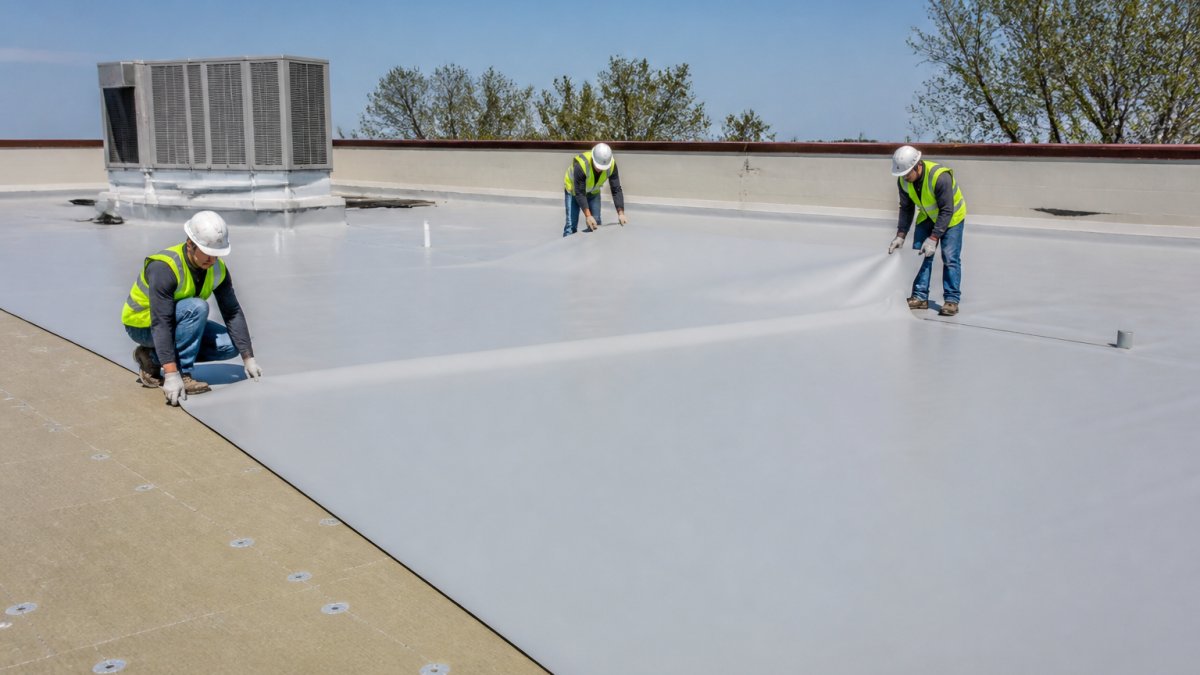
Thermoplastic Membrane and Factory-Welded Seams
A thermoplastic membrane is a plastic-based roofing sheet that softens when heated and fuses permanently when cooled. Duro-Last panels arrive with factory-welded seams already completed, which reduces field seaming to a small fraction of the total roof area. Where panels must join on site, crews use heat or solvent welding rather than adhesive, and T-patches cover the intersections.
Custom-Cut Panels and Faster Installation
Each panel is cut to the dimensions of the actual building, including penetrations for HVAC curbs, skylights, and drains. Fewer cuts mean fewer field seams, and fewer field seams mean less on-site labor. Installation efficiency is the practical payoff: a crew spends less time on the roof, which shortens disruption for a commercial tenant or a homeowner.
Duro-Last Roof Lifespan and Long-Term Performance
Duro-Last roof lifespan depends on membrane thickness, foot traffic, drainage, and how consistently the roof is inspected. Manufacturers of thermoplastic single-ply systems generally design these membranes for decades of service, though real service life varies by building and climate.
What we tell property owners is this: the membrane is rarely the weak point. The weak points are penetrations, drainage, and deferred maintenance.
Energy Efficiency and Weather Resistance
Energy performance and weather resistance are the two claims buyers hear most often, and they deserve separate treatment because they behave very differently in the field.
How Reflective Membranes Actually Save Energy
A cool roof is a roof surface designed to reflect sunlight and stay cooler than a conventional dark roof. Light-colored thermoplastic membranes fit that description, and their performance is rated under two standards most specifiers recognize: solar reflectance (how much sunlight the surface bounces back) and thermal emittance (how efficiently the surface releases absorbed heat). The Cool Roof Rating Council maintains product listings for both metrics, and building energy codes in many jurisdictions reference cool-roof requirements for low-slope commercial roofs.
What that means in practice is narrower than the marketing suggests. Reflective membranes reduce heat gain through the roof assembly, which lowers cooling load in air-conditioned buildings during warm months. The savings depend on four variables:
- Insulation above the deck. A reflective membrane over well-insulated roof assembly saves less than the same membrane over a poorly insulated one, because the ceiling no longer dominates heat flow.
- Climate. Cooling-dominated climates see more benefit than heating-dominated ones. In cold climates, a highly reflective roof can slightly increase heating demand in winter, though the effect is usually small relative to cooling savings.
- Building use and internal loads. Warehouses with low internal heat gain respond differently than restaurants or data rooms with high year-round cooling demand.
Treat any single “saves X%” figure with suspicion unless it states the climate zone, insulation level, and baseline roof it was measured against. A common pattern is that quoted savings come from a specific building type in a specific climate and do not transfer.
Weather Resistance: What the Membrane Is Built to Handle
Weather resistance is the stronger and more defensible claim for thermoplastic single-ply systems, and it breaks down into four mechanisms:
- UV degradation. Thermoplastic PVC membranes are formulated with UV stabilizers and, in some products, a protective acrylic coating on the weathering surface. Without that chemistry, sunlight embrittles the plastic over time. The relevant question for a buyer is not whether the membrane is UV-resistant but how the manufacturer warranties UV performance over the service life.
- Ponding water. Standing water is the most common cause of premature membrane failure on low-slope roofs. The membrane itself resists prolonged water exposure, but ponding stresses seams, flashing, and insulation below. Correct slope to drains and properly sized drains matter more than membrane choice here.
- Chemical exposure. Commercial roofs see grease from kitchen exhaust, HVAC refrigerant oils, and occasional chemical spills. PVC offers good resistance to many of these, but not all, restaurant roofs and industrial roofs with specific chemical loads should be checked against the manufacturer’s chemical resistance chart before specifying.
The Honest Framing on Energy Savings
The membrane is one variable in a roof assembly, and it is rarely the largest one. If a building has old, wet insulation, upgrading insulation during a re-roof will usually move the energy bill more than switching to a reflective membrane. If the building is already well insulated and cooling-dominated, the reflective surface contributes a smaller but real reduction in peak cooling demand.
What Duro-Last Roofing Cost Actually Covers
Duro-Last roofing cost reflects more than membrane square footage. A quote typically includes tear-off and disposal, roof deck repair, insulation, membrane and accessories, fasteners, flashing, and labor. Custom fabrication adds factory time but removes field labor, so the two often offset.
Because pricing varies so widely by roof size, access, and deck condition, we do not publish a single number. For a realistic benchmark before you compare quotes, review our commercial flat roof replacement cost guide to see what a full replacement typically involves.
Duro-Last vs. TPO Roofing: Key Differences
Both are thermoplastic single-ply membranes, so the comparison is closer than most buyers expect. The meaningful differences are fabrication, seam method, and installation labor.
| Factor | Duro-Last | TPO |
|---|---|---|
| Panel fabrication | Custom-cut in factory | Often cut on site |
| Seam method | Mostly factory-welded | Mostly field-welded |
| Installation labor | Lower field labor | Higher field labor |
| Best for | Complex roofs, tight schedules | Simple, large open decks |
TPO is a fine membrane and often costs less per square on a simple roof. Where Duro-Last earns its place is complexity: the more penetrations and edges a roof has, the more the factory fabrication pays for itself.
Duro-Last Roof Maintenance and Warranty Coverage
Most roofing articles stop at installation. What happens over the next 15 to 25 years is where the real ownership cost and the real value of a warranty live, and it is the part buyers ask about after the quote is signed.
What Routine Maintenance Actually Involves
Duro-Last roof maintenance is straightforward, which is part of the appeal, but “straightforward” is not the same as “optional.” A practical annual routine looks like this:
- Clear drains and scuppers before and after storm season. Clogged drains are the single most common cause of ponding water, and ponding water is the most common cause of seam and flashing failure. This is a 30-minute task that prevents most of the expensive problems.
- Walk the perimeter and penetrations. Check sealant at pipe boots, HVAC curbs, and edge metal. Sealant has a shorter service life than the membrane, so it is the first thing to fail.
- Keep foot traffic off the membrane where possible. If the roof is a service route for HVAC technicians, install walkway pads. Repeated traffic on the same path wears the surface and stresses seams.
Most problems found on Duro-Last roofs are clogged drains and failed sealant at penetrations, not membrane failure. That pattern matters because those are the items a maintenance program is designed to catch, and because they are the items most likely to be excluded from warranty coverage if they are neglected.
How the Warranty Is Structured
Duro-Last warranties are not a single document. They typically come in tiers that differ by coverage length and by what is included, and the tiers are usually tied to whether the roof was installed by an authorized contractor and whether the membrane, accessories, and fasteners all came from the same system. A common structure is:
- A membrane-only or materials warranty covering defects in the membrane itself.
- A labor-and-materials warranty that adds coverage for the installer’s workmanship, typically available only through authorized contractors.
- A no-dollar-limit or total-system warranty that covers repair or replacement of the membrane and associated labor, usually the top tier and the one most dependent on proper installation and documented maintenance.
Coverage length varies by product and program, so the number on the brochure is less important than the terms behind it.
Exclusions and Conditions to Read Before You Sign
Every roofing warranty has exclusions, and the exclusions are where most disputes originate. Read the terms for these specifically:
- Ponding water. Many warranties exclude damage caused by ponding water beyond a defined threshold, which is why drainage design matters at installation.
- Foot traffic and mechanical damage. Damage from HVAC technicians, other trades, or dropped tools is usually excluded or covered only at the manufacturer’s discretion.
- Structural movement and deck failure. A warranty covers the membrane system, not the building structure beneath it.
The Claim Process in Practice
When a leak appears, the sequence matters. Notify the original installer and the manufacturer promptly, document the leak with photos and dates, and do not authorize a third-party repair before the manufacturer inspects, an unauthorized repair is one of the fastest ways to complicate a claim. The manufacturer typically sends a representative to inspect, determines whether the cause is covered, and either authorizes repair through an authorized contractor or denies the claim with a written reason.
The warranty is only as good as the maintenance behind it and the contractor standing behind the installation. Ask three questions before signing: What tier of coverage am I getting, what voids it, and who performs the repair when I call? If the answers are vague, the warranty is vague.
Where Duro-Last Falls Short
Duro-Last is not the right answer for every roof, and we say so on estimates.
- Simple, large, open roofs. On a big unobstructed deck, a field-seamed membrane can be more economical.
- Tight budgets. Custom fabrication carries a cost that a commodity membrane avoids.
- Severe deck deterioration. No membrane fixes a failing substrate; deck repair comes first.
If your concern is recurring leaks rather than membrane choice, our breakdown of why flat roofs leak and how to fix them covers the causes we find most often.
Request a Free Duro-Last Roofing Estimate
The real test of any roofing system is the crew behind it. United Roofing of Colorado is a locally owned, certified Duro-Last installer with over 30 years of combined industry experience, and we handle residential and commercial flat roofs across the region.
If you are weighing options, review the professional flat roofing services we offer, then get a free roofing estimate and a straight answer about whether Duro-Last fits your building.
Frequently Asked Questions
How long does a Duro-Last roof last?
Duro-Last publishes a 15-year commercial warranty and a 20-year residential warranty on its membrane systems, and many installations reach 20 to 30 years with proper care. Actual Duro-Last roof lifespan depends on foot traffic, ponding water, and how quickly small issues get repaired. Factory-welded seams remove the field seams that fail first on many single-ply roofs, which is the main reason the membrane holds up so long.
What factors affect Duro-Last roofing cost?
Duro-Last roofing cost depends on roof square footage, deck condition, insulation thickness, tear-off of the old roof, and how many penetrations like vents and skylights need flashing. Complex layouts with many curbs and drains take more custom fabrication and labor. Because pricing varies by project, ask a certified installer for a written estimate rather than relying on a national average.
Is Duro-Last a good choice for a flat or low-slope roof?
Yes. Duro-Last is a thermoplastic single-ply membrane made for flat and low-slope roofs where standing water and snow load are real concerns. The membrane resists ponding water, UV exposure, and chemicals, and the factory-welded seams stay watertight in freeze-thaw cycles. It suits commercial buildings, self-storage facilities, and homes with flat roof sections.
How does Duro-Last compare with TPO roofing?
Both are thermoplastic single-ply membranes, but they differ in how they are assembled. Duro-Last panels are custom-cut and welded in a factory, so most seams never touch the job site. Standard TPO is seamed in the field with hot-air welding, which puts seam quality in the hands of the crew and the weather that day. Duro-Last usually costs more up front and installs faster with less disruption.
What maintenance does a Duro-Last roof require?
Schedule an inspection twice a year and after major storms. Crews clear drains and scuppers, remove debris, and check flashings around penetrations. Keep foot traffic off the membrane and use walkway pads on service routes. Small punctures and T-patch repairs are straightforward on thermoplastic membrane, which keeps repair costs low and protects the warranty.
Can a Duro-Last roof be repaired if it is damaged?
Yes. Thermoplastic membrane repairs are simple: a certified installer cleans the area and hot-air welds a patch of matching membrane over the damage. Because the patch fuses into the existing sheet, the repair is as watertight as the original seam. Prompt repairs also protect warranty coverage, since most warranties require reasonable maintenance and quick action on damage.
A flat roof that leaks every few years is not a roofing problem, it is a diagnosis problem. United Roofing of Colorado installs Duro-Last systems with factory-welded seams, custom-fitted panels, and efficient project turnaround so the roof stops being the thing you worry about. Get started with United Roofing of Colorado and request your free roofing estimate today.
