
Last Updated: November 2, 2026
Quick Summary
The best roofing for high altitude is an assembly question, not a single material: standing-seam metal sheds snow on steep pitch, slate delivers the longest life where framing can carry its weight, and every option needs ice-and-water shield at eaves and valleys. Confirm your site’s ground snow load and drift exposure before choosing.
- Standing-seam metal with concealed fasteners sheds snow in sheets on steep pitches and resists wind uplift.
- At elevation, UV degrades asphalt shingle binders faster, shortening lifespan versus sea-level ratings.
- Slate resists fire, hail, and wind but demands structural capacity and a roofer skilled in slate repair.
- Self-adhering ice-and-water shield belongs at eaves, valleys, penetrations, and low-slope transitions.
- Ask any bidder for the design snow load and how the proposed assembly meets it.
Table of Contents
- Why High-Altitude Roofing Is a Different Problem
- The Best Roofing Material for Mountain Climates: A Side-by-Side Comparison
- Metal Roofing for Mountain Homes: Standing Seam and Snow Shedding
- Asphalt Shingles, Slate, and Tile at Elevation
- Roofing for Heavy Snow: Load, Pitch, and Structural Capacity
- Ice Dam Prevention Roofing: Underlayment, Flashing, and Ventilation
- Lifecycle Cost, Maintenance, and Repair Logistics at Elevation
- Getting a Free Roofing Estimate for Your High-Altitude Property
- Frequently Asked Questions
Why High-Altitude Roofing Is a Different Problem
Elevation changes what a roof has to survive, which is why the best roofing for high altitude is a different problem entirely. According to RubyHome’s roofing statistics, asphalt shingles appear on roughly 80% of roofing projects and average roof lifespan runs 20 to 50 years, but those general figures assume general conditions. At 8,000 or 9,000 feet, the rules shift.
Stronger ultraviolet radiation breaks down asphalt binders faster, and Highlander’s high-elevation roofing guide notes this shortens shingle life. Freeze-thaw cycles work on flashing and sealant seams all winter. Snow sits longer, and meltwater refreezes at the eaves.
That combination is why finding the best roofing for high altitude is a materials-and-assembly question, not a shingle-versus-metal argument. United Roofing of Colorado works on flat and low-slope roofing systems, and elevation makes every seam critical. Below, we break down which materials hold up, where each one fails, and what the installation details have to get right.
The Best Roofing Material for Mountain Climates: A Side-by-Side Comparison
No single material wins everywhere. The best roofing material for mountain climates depends on pitch, snow load, budget, and how far you are from a qualified installer.
| Material | Snow & Ice Behavior | Wind & Hail | Lifespan | Watch Out For |
|---|---|---|---|---|
| Standing-seam metal | Sheds snow well on steep pitch | Excellent wind resistance | Long | Snow guards needed over walkways |
| Architectural asphalt | Holds snow; ice dams at eaves | Moderate | Shorter at elevation | UV degrades binders faster |
| Slate | Heavy; needs structural capacity | High fire, hail, wind resistance | Very long | Weight and repair skill |
| Clay and concrete tile | Good with correct underlayment | Good hail resistance | Long | Brittle under foot traffic |
| Membrane (flat/low-slope) | Relies on drainage design | Good when mechanically attached | Long | Seam quality decides everything |
For a deeper walkthrough of how these options perform across mountain regions, see what is the best roofing for mountain regions.
Metal Roofing for Mountain Homes: Standing Seam and Snow Shedding
Metal roofing for mountain homes earns its reputation for one reason: it lets snow leave. A standing-seam profile with concealed fasteners and a smooth face gives snow little to grip, so on a steep pitch it slides in sheets rather than sitting and melting into the seams.
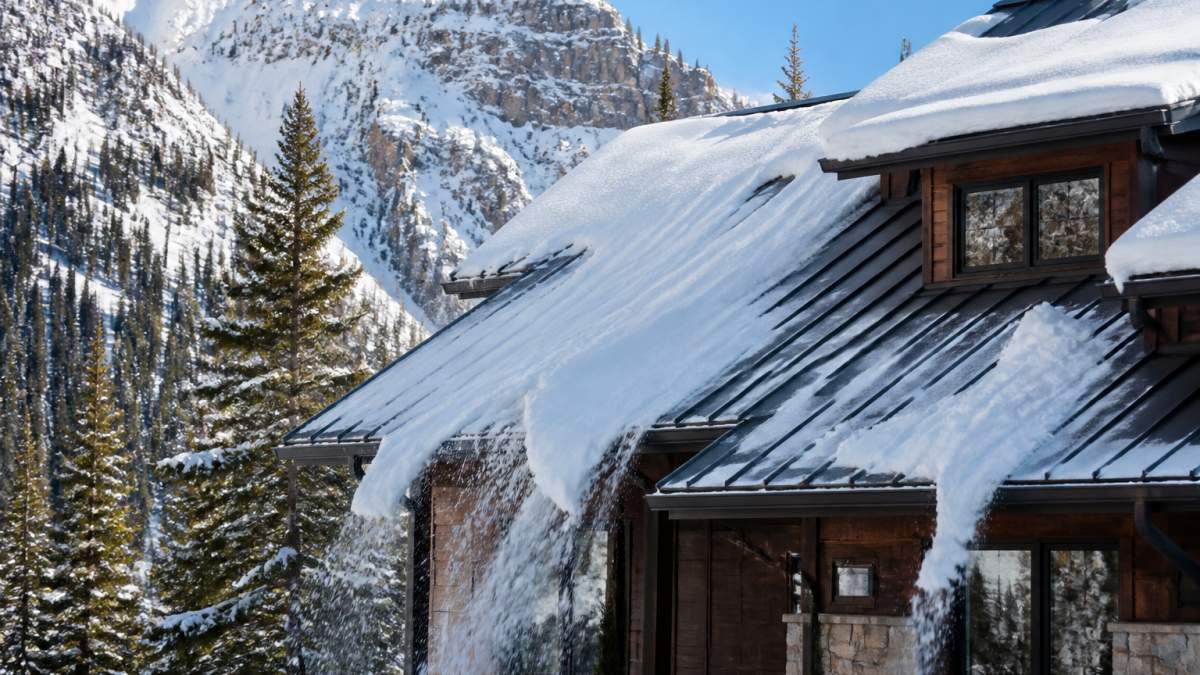
Wind resistance is the second advantage. Concealed clips and raised seams handle uplift pressure better than shingle tabs, which matters on exposed ridges. Corrosion resistance depends on the coating, so specify it for the climate rather than accepting a default.
Here is the honest limitation: snow shedding is a feature until it lands on a doorway, a gas meter, or a walkway. Snow guards are not optional decoration on a mountain home.
Asphalt Shingles, Slate, and Tile at Elevation
Asphalt shingles remain the budget option, and architectural shingles perform better than three-tab. Neither escapes the UV problem. At elevation, the binder that holds the granules together degrades faster, so a shingle rated for decades at sea level may deliver noticeably less up high.
Slate roofing is the longevity answer. It resists fire, hail, and wind, and it outlasts nearly everything else. The catch is weight: slate demands structural capacity, and repairs require a roofer who actually knows slate. On many older mountain homes, the framing decides the question before aesthetics do.
Clay tile and concrete tile sit in the middle. Both handle hail and sun well, both need a proper underlayment beneath them because tile is a rainscreen, not the waterproof layer, and both crack under careless foot traffic. A 2026 MDPI comparative study of high-altitude roofing systems found ceramic tile scored highest for landscape integration, a reminder that appearance counts in mountain communities with design review.
Roofing for Heavy Snow: Load, Pitch, and Structural Capacity
Roofing for heavy snow starts with arithmetic, not product selection.
How design snow load is established. In the United States, structural design snow loads come from ASCE 7, Minimum Design Loads and Associated Criteria for Buildings and Other Structures, and are adopted into the International Building Code and International Residential Code.
Why drifting decides the framing. Snow does not land evenly. Wind moves it off windward slopes and deposits it against dormers, parapets, valleys, mechanical curbs, and the leeward side of step-backs.
Pitch, shape, and slope categories. Steep roofs shed; low-slope roofs hold. A hip roof distributes both snow load and wind uplift better than a gable in many exposures, and a simple plane sheds more reliably than a cut-up design.
When a structural engineer is required. Structural engineering review is generally warranted for three triggers: (1) adding a heavier material, slate, tile, or a thick membrane assembly, to an existing roof without confirming the framing can carry the added dead load; (2) any roof with significant drift exposure, large valleys, or a history of sagging or ponding; and (3) any change of use or re-roof that increases load. A licensed structural engineer, not a roofing salesperson, should confirm capacity. Skipping that step is how a beautiful slate roof ends up overmatched by its own framing.
Two practical rules we apply:
- Never add a heavier material, slate or tile, without confirming the framing can carry it, dead load plus the design snow load, not dead load alone.
- On low-slope and flat sections, assume snow will sit. Design drainage and membrane seams for standing water, and confirm the deck meets the local ground snow load plus drift, not a generic national default.
Watch out: a contractor who quotes a material without asking for the site’s ground snow load and drift exposure is guessing about the one number that determines whether the roof is safe.
Ice Dam Prevention Roofing: Underlayment, Flashing, and Ventilation
Ice dam prevention roofing is an assembly problem: keep the roof deck cold, keep water out when dams form anyway, and give meltwater a path off the roof.
The mechanics, briefly. Heat escapes from the house, melts snow at the upper deck, water runs down and refreezes at the cold eaves, and the resulting dam backs water under shingles or membrane edges.
Underlayment: ice-and-water shield where it counts. A self-adhering waterproof underlayment, commonly called ice-and-water shield, belongs at the eaves, in valleys, around penetrations, and along any low-slope-to-steep transition.
Flashing detailed for ice, not just rain. Chimneys, skylights, wall intersections, and step flashing are where freeze-thaw does the most damage.
Ventilation and insulation together. Ventilation keeps the deck temperature close to outdoor air, which pairs with insulation recommendations, Local energy code may set insulation requirements, so confirm the applicable level for your building.
Eaves, valleys, and drainage path. Keep gutters and downspouts sized for snow and ice, and consider heat cable only as a supplement, not a substitute for a correct assembly.
What actually helps:
- A self-adhering waterproof underlayment at the eaves and in valleys, installed to the local code minimum, and beyond it where the jurisdiction requires.
- Ventilation paired with air sealing and insulation so the deck stays cold.
- Flashing detailed for ice at chimneys, skylights, and wall intersections, with counterflashing in a reglet rather than surface sealant.
Lifecycle Cost, Maintenance, and Repair Logistics at Elevation
The cheapest roof is rarely the lowest bid. Lifecycle cost at elevation is dominated by three things: how often the roof needs attention, how hard it is to get a crew out, and whether the warranty actually gets honored years later.
Remote properties pay a logistics premium. A repair that takes an hour in town can consume a day in travel, and small leaks left through a winter cause deck damage that turns a repair into a replacement. Maintenance access matters too, so plan for how someone will safely get onto the roof to clear drains and check seams.
Warranty coverage deserves the same scrutiny as the material. Before you commit, read how roofing warranty coverage works so you know what is excluded and who performs the work. Look for a local installer who will still be in business when a warranty call comes.
Getting a Free Roofing Estimate for Your High-Altitude Property
A useful estimate starts with the roof, not a price sheet. Any contractor quoting your project should inspect the deck, measure the actual slope, check ventilation and insulation, and confirm the structural capacity before recommending a material.
Ask three questions of any bid:
- What is the design snow load for this roof, and how does the proposed assembly meet it?
- Which underlayment, flashing, and ventilation details are included, and which are add-ons?
- Who performs warranty work, and how do I reach them in year five?
If you want a straight answer on a flat or low-slope assembly, request a free roofing estimate from United Roofing of Colorado.
High-altitude roofing depends on the details as much as the material. United Roofing of Colorado is a locally owned, certified Duro-Last installer with over 30 years of combined industry experience, providing flat and low-slope roofing installations for residential and commercial properties. Get started with United Roofing of Colorado and get a free roofing estimate for a roof designed for the elevation it sits on.
Frequently Asked Questions
What roofing material is best for high-altitude climates?
There is no single winner, but metal roofing and high-grade synthetic or composite shingles are the materials contractors most often recommend for mountain homes. Standing-seam metal handles snow shedding, wind uplift, and UV exposure well. Slate and concrete tile last decades but add structural weight. Asphalt shingles are the most common roof in the country, yet stronger UV radiation at elevation breaks down their binders faster, so shingle life shortens as you climb.
Is metal roofing a good choice for mountain homes?
Yes, with caveats. Metal roofing for mountain homes earns its reputation through wind resistance, snow shedding, and reflective finishes that lower summer heat gain. Contractors qualify the recommendation: standing-seam metal is excellent for the conditions if cost and local regulations align. It usually costs more upfront than asphalt, and it needs correct fastening and panel detailing so uplift pressure at ridgelines and eaves does not pull seams apart.
How does high-altitude UV exposure affect a roof?
UV radiation intensifies with elevation, and it attacks the binder that holds asphalt shingles together. Stronger UV at elevation breaks down asphalt binders faster, shortening shingle life compared with the same product at sea level. Metal, slate, and tile resist UV degradation far better. Reflective or light-colored finishes also cut heat gain, which matters on south- and west-facing slopes that take the most sun.
How do you prevent ice dams on a high-altitude roof?
Ice dam prevention roofing starts with the roof assembly, not the surface material. Balanced ventilation and adequate insulation help keep the roof deck cold so snow does not melt and refreeze at the eaves. Add a water-tight membrane underlayment at the eaves, keep flashing detailed at valleys and penetrations, and seal air leaks into the attic.
Which roofing materials handle heavy snow and ice best?
Smooth, hard surfaces shed snow best. Standing-seam metal releases snow in slides, and slate and tile also shed well when the roof pitch is steep enough. Roofing for heavy snow also depends on structural capacity: snow load is measured in pounds per square foot, and slate or concrete tile add significant dead load on top. A structural check before installation matters as much as the material choice.
How often should a roof be inspected in a mountain climate?
Plan on an inspection every year, ideally in late fall before the snow arrives, plus a check after any major hail or wind event. Freeze-thaw cycles open small gaps at flashing and seams, and ice dams stress the eaves. Catching a lifted seam or worn sealant in autumn costs far less than repairing water damage in spring. Ask the inspector to look at attic ventilation and insulation levels at the same time.
