
Last Updated: November 21, 2026
Quick Summary
To get a commercial roof repair quote that holds up, have a contractor inspect the roof in person and give you a written, itemized quote covering the repair area in squares, materials by manufacturer, wet insulation and decking contingencies, disposal, and warranty terms. Compare quotes line by line on equal assumptions, not by total price alone.
- Commercial roofing demand reached 83.2 million squares in 2024, projected to grow less than 1.0% annually through 2029.
- A quote should state the measured repair area in squares, since one square equals 100 square feet.
- Ask whether wet insulation removal and decking repair are included, excluded, or priced per square.
- Repair is the better call when damage is isolated and the membrane still has service life left.
- Compare repair and replacement on cost per year of service life, not sticker price.
Table of Contents
- What a Commercial Roof Repair Quote Should Tell You
- Start With a Commercial Roof Inspection Before Any Numbers
- Information to Gather Before You Request a Quote
- What Drives Commercial Roof Repair Cost
- Reading the Commercial Roof Repair Scope of Work
- How to Compare a Commercial Roofing Estimate Line by Line
- Repair or Replace: Deciding Before You Sign
- Request Your Free Roofing Estimate
- Frequently Asked Questions
What a Commercial Roof Repair Quote Should Tell You
A commercial roof repair quote should tell you exactly what is wrong, what will be done to fix it, what materials will be used, and what it will cost, in writing, before any work starts.
Demand for commercial roofing work is steady but not booming.
Below, we break down how to get a commercial roof repair quote that holds up, from inspection to signature.
Start With a Commercial Roof Inspection Before Any Numbers
Any credible commercial roofing estimate begins with someone physically on your roof. Not a drone photo. Not a satellite image. A person walking the membrane, checking seams, probing wet insulation, and looking at drainage.
A proper commercial roof inspection covers four things:
- Membrane condition across the full field, not just the visible leak area
- Seam and flashing integrity, especially around penetrations and walls
- Drainage and ponding, since standing water shortens roof life
If a contractor quotes your job without getting on the roof, ask why. A small, obvious leak can occasionally be scoped from below, but most cannot.
Information to Gather Before You Request a Quote
The fastest way to get an accurate commercial roof repair quote is to hand the contractor good information up front.
Building Details and Roof History
Pull together what you know before you call:
- Building age and approximate roof age
- Roof type and membrane material, if known
- Past repairs, including who did them and when
Old warranty paperwork matters more than most owners realize. If your roof is under a manufacturer warranty, certain repairs must be performed by certified installers or coverage may be voided.
Access, Occupancy, and Timing Constraints
Tell the contractor how materials will reach the roof and when they can work. Rooftop access, elevator availability, parking, and business hours all affect scheduling and labor.
Be upfront about tenants, inventory, or equipment beneath the work area. A contractor who knows your constraints plans for them; one who finds out on day one improvises, and improvisation costs you.
What Drives Commercial Roof Repair Cost
Commercial roof repair cost depends on a handful of factors, none of them arbitrary. Understand the drivers and you can read a quote and see whether the number makes sense.
The main cost drivers are:
- Roof size and repair area, measured in squares (one square equals 100 square feet)
- Membrane type, since some materials and seams take more labor to repair
- Access difficulty, including height, obstructions, and material handling
A quote that lists these factors separately is one you can trust. A quote that lumps everything into one line is one you cannot verify.
How Each Driver Shows Up on an Itemized Quote
A repair quote built to be compared breaks the work into measurable lines. Here is what each line should look like and why it matters:
- Repair area in squares. The contractor should state the measured area, not a guess; a 20-square and a 2-square repair use different crews, material quantities, and mobilization. Without a stated area, you cannot compare quotes on equal footing.
- Membrane and seam materials by manufacturer. TPO, EPDM, PVC, modified bitumen, and built-up roofs each have different seam methods and repair details. A membrane-specific repair kit costs more than a generic patch, but it is the only path to keeping a manufacturer warranty intact. The quote should name the product, not say “standard membrane.”
- Labor and access. Height, roof hatches, elevator availability, parapet walls, and HVAC congestion all change how long a crew takes to move materials and set up. Ask the contractor to state the access method in the quote.
Repair Pricing Versus Replacement Pricing
Repair and replacement quotes are not built the same way, and comparing them directly leads to bad decisions.
That difference matters because a repair quote can look small next to a replacement quote even when the repair is poor value.
Watch out: the cheapest quote often omits wet insulation replacement and disposal. That work gets discovered mid-project and added as a change order, landing the final bill well above the original number.
Questions That Turn a Number Into a Real Quote
When you receive a repair quote, ask these questions before you compare totals:
- How many squares are being repaired, and how was that area measured?
- What membrane and seam materials are specified, by manufacturer and product name?
- Is wet insulation removal and replacement included, excluded, or priced as a unit rate per square?
- Is decking repair included, and if not, what is the unit rate if it is found?
- What access method is assumed, and does the price change if access is harder than expected?
- Are disposal and haul-off included?
- Is any of the work after-hours or emergency, and is that premium broken out?
- What is the payment schedule, and is it tied to milestones rather than a large upfront deposit?
A contractor who can answer these questions in writing has given you a quote you can evaluate. One who cannot has given you a number and a hope.
Reading the Commercial Roof Repair Scope of Work
The commercial roof repair scope of work describes exactly what will be done. Read it like a contract, because that is what it is.
A solid scope of work names the specific repair method, the materials and manufacturer, the quantity of each, and the sequence of work.
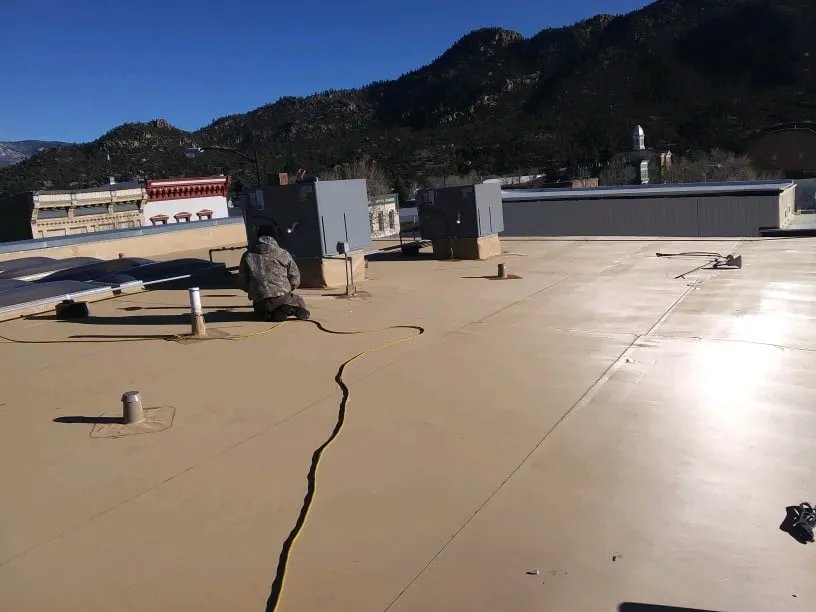
Here is what to look for, and what to question:
- Materials named by product and manufacturer, not “standard membrane”
- Quantities listed, so you can compare quotes on equal footing
- Warranty terms spelled out, including labor and manufacturer coverage
If warranty language in the quote is thin, read more about finding reliable roofing warranty coverage before you sign. You can also review the flat roof repair mistakes Colorado owners make to spot red flags in how the work is being scoped.
How to Compare a Commercial Roofing Estimate Line by Line
Comparing commercial roofing estimates means lining up the same items across every quote and checking that each contractor is pricing the same work. Apples to apples, or the comparison means nothing.
Build a simple grid: each line item down the left side, each contractor across the top. Fill in the numbers. Gaps tell you as much as totals.
The Quote Comparison Checklist
Use this checklist on every quote you receive:
- Inspection performed on the roof, in person
- Repair area measured and stated in squares
- Membrane and materials named by manufacturer
If you want to know how to vet the companies behind those numbers, our guide on how to choose a commercial roofing company walks through the questions that separate real contractors from call centers.
| Quote Element | What It Tells You | Red Flag If Missing |
|---|---|---|
| Inspection notes | Whether the diagnosis is real | No roof access documented |
| Repair area in squares | Scope size and pricing basis | Vague “miscellaneous repair” |
| Materials by manufacturer | Quality and warranty eligibility | Generic “standard materials” |
| Wet insulation line | Hidden cost exposure | No mention at all |
| Warranty terms | Long-term protection | “Standard warranty” with no details |
| Payment schedule | Contractor cash position | Large upfront deposit required |
Repair or Replace: Deciding Before You Sign
Repair makes sense when damage is isolated, the membrane has years of service left, and the decking is sound. Replacement makes sense when repairs keep recurring, ponding is chronic, or the roof is near the end of its warranty period. The hard part is applying those rules to a specific roof with a specific leak history and budget.
Indicators That Repair Is the Right Call
Repair is usually the better decision when most of these are true:
- The damage is isolated. One leak, one failed seam, or one damaged penetration, not a pattern across the field.
- The membrane has service life left. If the roof is well within its expected service life and the manufacturer warranty is still active, repair protects that asset.
- The decking and insulation are sound outside the repair area. A moisture scan or core sample can confirm this. If wet insulation is widespread, a spot repair will not solve the problem.
Indicators That Replacement Deserves Serious Consideration
Replacement is usually worth pricing when several of these are true:
- Repairs are recurring. If you have paid for three or more repairs in the past two years, or the same area keeps failing, you are funding a pattern, not a fix.
- The roof is near or past its expected service life. Most commercial membrane roofs have a known expected service life, and a roof at the end of that window will keep generating repair calls.
- Wet insulation is widespread. Saturated insulation loses R-value and can lead to deck corrosion. If a moisture survey shows broad saturation, repair becomes a patch on a bigger problem.
How to Compare the Two Numbers Fairly
Comparing a repair quote to a replacement quote is not apples to apples unless you normalize them. Ask for both quotes with the same assumptions: same access method, disposal scope, warranty terms, and payment schedule.
A repair that costs a fraction of replacement but only buys two years is not cheaper than a replacement that buys twenty. Compare cost per year of service life, not sticker price.
What to Ask the Contractor to Document
Before you sign either quote, ask the contractor to put the following in writing:
- The reasoning for recommending repair over replacement, or the reverse, tied to specific findings from the inspection.
- The measured repair area in squares and the percentage of the total roof area it represents.
- Whether the repair is expected to be a permanent fix or a bridge to replacement, and the expected service life of the repair.
- The condition of the existing membrane, insulation, decking, and drainage outside the repair area.
- How the repair affects any existing manufacturer warranty, and what workmanship warranty covers the repair itself.
- The unit rates for wet insulation removal and decking repair if unexpected damage is found.
A good roofer will give you a straight answer and put it in writing. A bad one will push whichever job pays more. If you are weighing that decision, our commercial flat roof replacement cost guide lays out the pricing factors so you can compare fairly.
Request Your Free Roofing Estimate
Getting a commercial roof repair quote that holds up comes down to preparation and comparison. Inspect first. Gather your building details. Understand the cost drivers.
If you are ready to move forward, you can book professional flat roofing services and get a free estimate from a team that will still be here when the warranty matters.
Your roof will not fix itself, and a vague quote will not protect you when the next leak shows up.
Frequently Asked Questions
What information do I need to get a commercial roof repair quote?
Have your building address, roof square footage, roof type and age, and a short history of past repairs and leaks ready. Note any active leaks, ponding water, or interior damage, and mention access details such as roof hatches, ladders, or tenant schedules. Photos of problem areas help, but a contractor should still perform an onsite commercial roof inspection. The more accurate the details you supply, the closer the first commercial roofing estimate will be to the final invoice.
What should a commercial roof repair estimate include?
A complete estimate lists the repair scope of work, materials and manufacturer, labor, tear-off and disposal, permit costs, and any temporary leak mitigation. It should state the warranty terms, the project timeline, and payment schedule. Ask whether the price covers unforeseen deck or insulation damage and how change orders are handled. An itemized commercial roofing estimate lets you compare bids fairly instead of judging a single bottom-line number that may hide exclusions.
How do I compare commercial roofing quotes fairly?
Line up each bid against the same scope of work. Check that all contractors specify the same materials, membrane thickness, and warranty length. Look for exclusions, allowances for hidden damage, and whether permits and disposal are included. A low commercial roof repair cost may reflect a narrower scope or a shorter warranty rather than a better deal. Ask each contractor to explain anything missing, and confirm they are licensed, insured, and manufacturer-certified before you decide.
Should a contractor inspect a commercial roof before providing a quote?
Yes. A commercial roof inspection is the only reliable way to price a repair. A contractor who quotes from a photo or a phone call is guessing, and that guess often grows once work starts. An onsite visit reveals the roof condition, leak source, moisture in insulation, and drainage problems. Schedule the inspection, ask for a written damage assessment, and expect the commercial roofing estimate to follow from what was actually found on the roof.
How long does it take to get a commercial roof repair quote?
Most contractors can schedule a commercial roof inspection within a few days, with a written quote following shortly after the visit. Complex roofs with multiple leak sources or moisture testing can take longer. Ask for a firm timeline when you call, and request temporary leak mitigation if water is entering the building. A contractor who responds promptly to the quote request is a useful signal of how they will handle the repair itself.
