
Last Updated: November 4, 2026
Quick Summary
Duro-Last is a prefabricated PVC membrane system where most seaming happens in a factory, while traditional roofing means shingles, built-up roofing, or field-assembled single-ply assembled on site. That distinction drives installation time, leak risk, and long-term durability.
- Duro-Last material generally costs more up front than traditional systems, but traditional systems often spend the savings on labor and waste.
- In 2026, TPO runs roughly $7 to $12 per square foot and PVC systems like Duro-Last roughly $9 to $14 per square foot.
- A 2008 Roofing Contractor case study reported 80% to 85% of Duro-Last membrane seaming is completed in a factory.
- Compare the 20-year total cost rather than the day-one invoice when weighing Duro-Last against traditional roofing.
- Manufacturer material warranties and contractor workmanship warranties are separate, and workmanship coverage is typically much shorter.
Table of Contents
- Duro-Last vs Traditional Roofing Materials: The Core Differences
- Duro-Last Roofing Specifications: Membrane, Seams, and Materials
- Duro-Last vs Traditional Roofing Materials Cost: What Drives the Price
- Duro-Last Roof Lifespan and How Traditional Materials Compare
- Duro-Last vs TPO Roofing: Two Single-Ply Systems Side by Side
- Performance in Practice: Snow, Wind, Ponding Water, and Sun
- Maintenance, Warranties, and What Happens After the Install
- Get a Free Duro-Last Roofing Estimate
- Frequently Asked Questions
Duro-Last vs Traditional Roofing Materials: The Core Differences
The U.S. roofing market was valued at USD 31.50 billion in 2025 and is forecast to reach USD 33.47 billion in 2026, according to Market Data Forecast’s U.S. Roofing Market report.
The core difference is where the roof gets built. Duro-Last is a prefabricated PVC membrane system: most of the seaming happens in a factory, not on your roof deck. Traditional roofing means shingles, built-up roofing, or field-assembled single-ply, where crews cut, fit, and seam everything on site.
That single distinction drives almost everything else: installation time, leak risk, and how the roof holds up over years of Colorado snow and sun.
How Factory Fabrication Changes the Installation
A 2008 Roofing Contractor case study on Duro-Last reported that 80% to 85% of roof-deck membrane seaming is completed in a controlled factory environment. Fewer field seams means fewer places for water to find a way in.
Traditional roofing flips that ratio. Crews assemble the system on your building, often over several days, exposed to weather the whole time. Duro-Last sections arrive custom-cut, so installers spend their time fitting and fastening rather than measuring and gluing.
For a building owner, the practical result is less disruption and a shorter window when the roof is open to the sky.
Duro-Last Roofing Specifications: Membrane, Seams, and Materials
Duro-Last roofing specifications center on a thermoplastic PVC membrane with heat-welded seams. The manufacturer states its PVC formulation provides long-term weathering and UV resistance, and that the membrane can withstand ponding water and continually wet or damp conditions (Duro-Last membrane details).
Key specification points:
- Thermoplastic PVC membrane that is recyclable
- Heat-welded seams for seam integrity instead of adhesive-only joints
- Deck sheets that can be mechanically attached or adhered to the roof substrate
- Custom fabrication of large sections, reducing on-site seams and rooftop labor
Traditional materials vary widely here. Asphalt shingles, still used in roughly 80% of roofing projects per RubyHome’s 2026 roofing statistics, are not designed for flat decks at all. Built-up roofs rely on layered field application. Each approach has different tensile strength, thermal expansion behavior, and mil thickness.
Duro-Last vs Traditional Roofing Materials Cost: What Drives the Price
Duro-Last vs traditional roofing materials cost comes down to material price, labor, waste, and what happens after the install. A contractor comparison notes Duro-Last is more expensive than TPO while arguing its material is higher quality (HHH Roofing’s Duro-Last vs TPO comparison).
In 2026, cost estimates put TPO at roughly $7 to $12 per square foot and PVC systems like Duro-Last at roughly $9 to $14 per square foot (The Roofing Brief’s Duro-Last review). Those are national material estimates, not quotes for your building.
What traditional systems save on materials, they often spend on labor and waste: more crew hours, more field seams, more offcuts. For a closer look at what a full replacement involves, see our guide to commercial flat roof replacement cost.
Lifecycle Cost Analysis: Where the Cheap Roof Gets Expensive
A lower bid is not a lower cost. Lifecycle cost analysis (LCCA) adds up material, installation, maintenance, repairs, and replacement over the roof’s service life, then discounts those costs to present value.
Build the comparison in four buckets:
- Initial installed cost. Membrane, fasteners, insulation, flashing, labor, and disposal.
- Routine maintenance. Every flat roof needs drain clearing and annual inspection. The difference is how often seams, flashings, and penetrations need attention. Field-seamed systems have more seam feet to inspect and repair; factory-seamed Duro-Last shifts most of that seam risk off the roof.
- Repair frequency and cost. A single seam failure on a field-assembled roof can mean opening insulation, drying the deck, and re-welding in place. Flashing, drains, and penetrations still fail on any system.
- Replacement timing. A roof that fails at year 15 instead of year 20 forces a second full install inside the same ownership window. That second install is the single largest LCCA line item, and it is the one most owners ignore at bid time.
A simple way to frame it: compare the 20-year total, not the day-one invoice.
Watch out: LCCA comparisons that use different discount rates, different maintenance assumptions, or different replacement years are not comparable. Ask for the assumptions in writing before you trust the total.
Duro-Last Roof Lifespan and How Traditional Materials Compare
Duro-Last roof lifespan depends on the membrane, installation quality, and maintenance.
Traditional material lifespan depends heavily on the system. Shingles on a low-slope roof fail early because they were never meant for standing water. Built-up roofs can serve for decades with steady maintenance. EPDM and TPO have their own service life profiles, and installation quality often matters more than the material label.
For a deeper look at what the Duro-Last system offers, read our overview of the benefits of Duro-Last roofing systems.
Duro-Last vs TPO Roofing: Two Single-Ply Systems Side by Side
Duro-Last vs TPO roofing is the comparison most commercial owners actually face, because both are single-ply membranes. TPO usually costs less per square foot. Duro-Last is PVC, factory-fabricated, and generally positioned at a price premium.
| Factor | Duro-Last (PVC) | TPO |
|---|---|---|
| Material cost (2026 estimate) | ~$9-$14/sq ft | ~$7-$12/sq ft |
| Seam method | Heat-welded, mostly factory-done | Heat-welded in the field |
| Fabrication | Custom prefabricated sections | Field-cut and fitted |
| Chemical and grease resistance | Strong PVC resistance | Moderate |
| Best for | Owners prioritizing seam integrity and low disruption | Budget-driven projects |
The 2026 RoofersCoffeeShop Trends Survey reports that industry professionals widely regard Duro-Last as a leading PVC product for durability, quality, and warranty offerings (RoofersCoffeeShop forum discussion).
Best for: owners who plan to hold the building long-term.
Skip if: the lowest initial number is the only deciding factor.
Performance in Practice: Snow, Wind, Ponding Water, and Sun
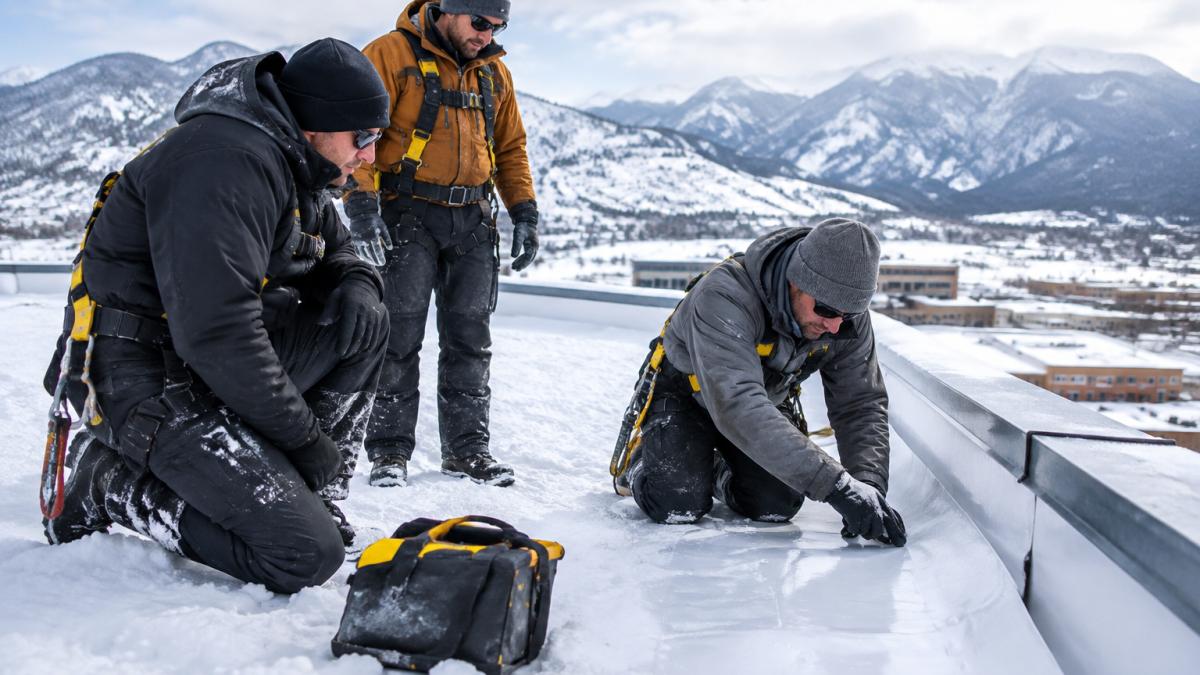
High-altitude buildings punish roofs. Snow load sits for months, freeze-thaw cycles work at every seam, and UV at elevation degrades materials faster.
Traditional field-seamed systems depend on the quality of each on-site weld, and one bad seam can become a leak.
Wind performance follows the same logic. Fewer seams and mechanical attachment to the roof substrate mean fewer edges for wind to lift.
Installation Failure Modes to Watch For
Most flat roof failures trace back to installation, not materials. Watch for these:
- Cold or rushed seam welds that pass inspection day one and open within a season
- Poor roof substrate preparation that lets the membrane flex and tear
- Inadequate flashing details at edges, penetrations, and drains
- Trapped moisture under the membrane that shows up as blistering later
For the rest, our guide on how to avoid common flat roof installation mistakes covers what to check.
Maintenance, Warranties, and What Happens After the Install
Duro-Last maintenance is straightforward: keep drains clear, schedule inspections, and address penetrations promptly. No roof is maintenance-free.
A practical maintenance cadence for a commercial flat roof looks like this:
- Twice a year: clear drains, scuppers, and gutters; remove debris that holds moisture against the membrane.
- Annually: walk the roof and inspect seams, flashings, edge metal, and penetrations; photograph and log anything suspicious.
- After severe weather: check for wind-lifted edges, hail bruising, and ponding that did not drain within 48 hours.
- Every few years: have a roofing professional inspect and document condition, especially before warranty milestones.
Keep the logs. Maintenance records are one of the first things a manufacturer asks for when a warranty claim is filed, and missing records are a common reason claims get denied.
Warranty Nuances: Manufacturer Coverage vs. Workmanship
Warranty nuances matter more than the headline term. Flat roof warranties come in two layers, and owners routinely confuse them:
- Manufacturer material warranty. Covers defects in the membrane and accessories themselves. Terms vary by product line and can run from a decade to several decades depending on the system and whether it is a standard or extended warranty.
- Workmanship warranty. Covers installation errors, the seams, flashings, and fastening the crew performed. This is typically much shorter than the material warranty and is backed by the contractor, not the manufacturer.
The split matters because most early roof failures are installation-related, not material defects. A 30-year material warranty does not help if the workmanship warranty expired at year two and a seam opens at year five.
Ask these questions before signing:
- What voids the warranty? Common triggers include unauthorized repairs, failure to maintain drains, added penetrations without proper flashing, and missed inspections.
- Who performs covered repairs? Some manufacturers require a certified installer; others allow any licensed roofer. Know which applies.
- Is the warranty backed by the manufacturer, the installer, or both? A long warranty from a contractor who disappears is worth nothing.
- Is it transferable? If you plan to sell the building, a transferable warranty can be a real asset, but transfer usually requires notice and sometimes a fee.
- Are there inspection requirements? Some extended warranties require periodic professional inspections to stay in force.
Warranty terms depend on the specific warranty tier and the installer’s certification. Our guide to finding reliable roofing warranty coverage walks through how to evaluate the terms.
Watch out: a workmanship warranty from a contractor with no track record is not equivalent to one from an established, certified installer, verify the company’s history and certification before you count on the coverage.
Get a Free Duro-Last Roofing Estimate
Comparing duro-last vs traditional roofing materials comes down to how long you plan to own the building and how much disruption you can absorb. If you want fewer seams, faster installation, and a system built for snow and ponding water, Duro-Last is worth pricing.
United Roofing of Colorado is a certified Duro-Last installer, locally owned and operated since 2014, with over 30 years of combined industry experience. We handle both residential and commercial roofs, with prompt service and convenient scheduling. You can find professional flat roofing services near you and request a free estimate.
Frequently Asked Questions
Is Duro-Last roofing good?
Duro-Last is a PVC membrane system. Installed pricing depends on your roof size and condition, so request a project-specific quote from United Roofing of Colorado.
How long does a Duro-Last roof last compared with traditional materials?
Traditional systems vary widely by material and installation quality. Seam integrity and maintenance matter as much as any headline lifespan number. Ask any contractor for the warranty terms in writing before you compare lifespans.
How much does Duro-Last roofing cost compared with traditional roofing materials?
Duro-Last vs traditional roofing materials cost depends on membrane thickness, roof complexity, tear-off, and insulation. Pricing depends on quantity, dates, and delivery. Get a written estimate for your building from United Roofing of Colorado.
Is Duro-Last PVC or TPO?
Duro-Last is PVC, not TPO. Both are single-ply thermoplastic membranes with heat-welded seams, but the formulations differ, and Duro-Last fabricates much of its seaming in a factory before the material reaches the roof. The decision comes down to whether the PVC membrane and prefabrication are the right fit for your building.
Can Duro-Last roofing be installed over an existing roof?
Whether a new roof can go over an existing one depends on the condition of the existing roof. The existing roof must be dry, structurally sound, and code-compliant as a substrate. A contractor should inspect the deck and moisture conditions first, because trapping wet insulation under a new membrane causes problems later. Ask for that inspection in writing.
Get a free Duro-Last roofing estimate from United Roofing of Colorado. We’ll inspect your roof, explain your options in plain terms, and give you a written quote with no pressure. Get started with United Roofing of Colorado and get a roof built to handle what your building actually faces.
