
Last Updated: November 5, 2026
Quick Summary
The best roofer for flat roofs is a contractor whose daily work is low-slope membrane systems, not a general shingle crew. Verify licensing, insurance, and manufacturer certification, and choose the contractor who can explain how your specific roof drains and puts seam and flashing details in writing.
- Flat roofs are a membrane trade where seams, flashing, drainage slope, and penetrations decide whether the roof lasts.
- Verify license, insurance, and bond yourself rather than trusting the contractor’s website.
- Ask for two or three flat-roof references from the past two years and call them.
- Confirm in writing who backs what: manufacturer covers material, installer covers workmanship.
- Ask each contractor to price the same written scope line by line so bids compare.
Table of Contents
- Why Flat Roofs Need a Specialist, Not a General Roofer
- How to Find a Reputable Roofer for Flat Roofing
- Questions to Ask a Roofing Contractor Before You Sign
- What Drives Flat Roof Replacement Cost
- Reading a Flat Roof Warranty: What Actually Gets Covered
- Matching Roofing Materials and Contractor Expertise to Your Building
- Requesting a Free Roofing Estimate
- Frequently Asked Questions
Why Flat Roofs Need a Specialist, Not a General Roofer
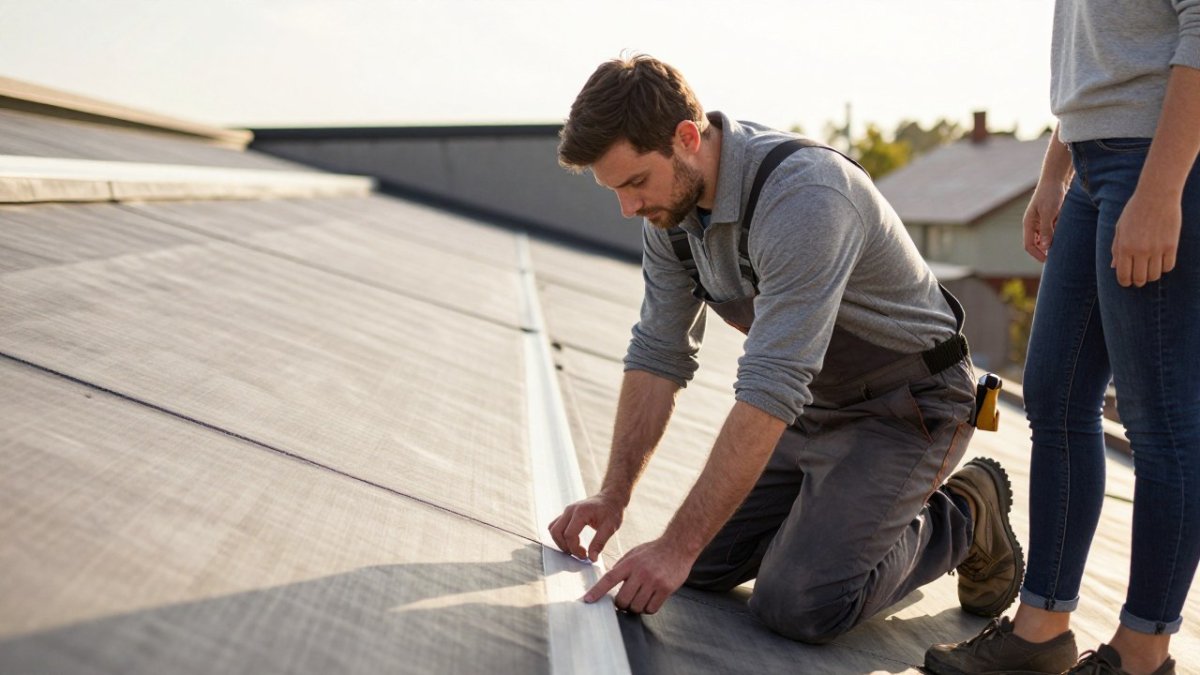
Flat roofs fail for reasons that have nothing to do with shingle work. Low-slope and flat roofing is a membrane trade: seams, flashing, drainage slope, and penetrations decide whether the roof lasts or leaks.
At United Roofing of Colorado, we install Duro-Last membrane systems on homes and commercial buildings.
The best roofer for flat roofs is not the busiest roofer or the cheapest bid. It is the contractor whose daily work is low-slope membrane systems, who can explain how your specific roof drains, and who will put the seam and flashing details in writing.
How to Find a Reputable Roofer for Flat Roofing
Start with a short list of contractors who name flat and low-slope membrane work as a specialty, not a side offering.
Ask what membrane systems they are certified to install. Manufacturer certification matters because it usually ties into the warranty.
Evaluating Reviews and Recommendations
Reviews tell you more about responsiveness and cleanup than about membrane quality. Read for patterns instead of star counts: repeated mentions of callbacks, warranty follow-through, and whether the crew showed up when promised.
A word of caution on recommendations. A neighbor’s praise for a shingle replacement does not transfer to a flat roof.
When you call those references, ask three questions: What membrane system was installed? How long ago? Has the roof leaked since, and if so, how quickly did the contractor respond? A reference who cannot answer those questions is not a useful reference.
The Vetting Checklist: Licensed, Bonded, and Insured
Use this list before you sign anything, and treat each line as something you verify rather than something you take on faith:
- License number verified with the state or local licensing body, look up the number yourself on the regulator’s public lookup, not just on the contractor’s website
- Certificate of insurance showing general liability and workers’ compensation, request it directly from the contractor’s insurer or agent, and confirm the policy is current and the limits are adequate for the project size
- Bond on file where your jurisdiction requires one, ask for the bond number and the surety company
- Manufacturer certification for the specific membrane proposed, ask for the certificate and confirm it covers the system and installation method being quoted
- Written scope naming materials, seam method, and flashing details
- Flat-roof references from the past two years
- Warranty documents in hand before the job starts
If a contractor cannot produce the insurance certificate on request, walk away. A common mistake is accepting a photocopy that has expired.
Watch out: a certificate of insurance can list the contractor as an additional insured on someone else’s policy, or show limits far below what your building is worth. Read the named insured and the limits, not just the expiration date.
Reading the Warranty and Contract Before You Sign
Most flat roof warranty disputes come down to a single distinction: manufacturer coverage versus the installer’s labor warranty. The manufacturer backs the membrane material. The installer backs the workmanship. If the installation was done wrong, the manufacturer can decline the claim, and your only recourse is the contractor.
Before signing, confirm four things in writing:
- Who backs what. Get the manufacturer’s warranty document and the contractor’s labor warranty as separate documents, and confirm the manufacturer warranty is not voided by the installer’s method.
- What is excluded. Ponding water, foot traffic, penetrations added later, and damage from other trades are commonly excluded. Ask the contractor to point to each exclusion in the document.
- Whether it transfers. If you sell the building, a non-transferable warranty is worth less to the next owner. Confirm the transfer terms and any fee.
- Who performs warranty repairs. Ask whether the original installer or the manufacturer handles claims, and how long a response takes.
A contract that names the membrane, seam method, flashing details, and warranty terms is the difference between a promise and an enforceable scope. If the contract is a one-page proposal with a price and a start date, ask for the full scope before you sign.
Questions to Ask a Roofing Contractor Before You Sign
The right questions separate a membrane specialist from a generalist quickly. Ask how they will handle drainage and slope, what seam method they use, how they will detail penetrations and parapet walls, and who performs warranty repairs if something fails.
Then ask the practical ones. What is the crew size, how many days will the building be exposed, and what is the plan if weather shuts the job down mid-installation?
For a deeper look at where installations go wrong, the common flat roof installation mistakes guide covers the pitfalls worth probing for in these conversations.
What Drives Flat Roof Replacement Cost
Flat roof replacement cost depends on square footage, membrane type, tear-off versus overlay, insulation and deck condition, drainage work, and access.
Pricing also moves with what the inspection finds. Rotted decking, saturated insulation, or failed flashing hidden under the membrane changes the scope once the old roof comes off. Any contractor who quotes without opening anything is estimating, not diagnosing.
For current figures to benchmark the estimates you receive, see the commercial flat roof replacement cost guide.
How Each Cost Driver Moves the Number
The final price is set by a handful of variables, and each one can move the estimate:
- Roof area and shape. Cost scales with square footage, but a simple rectangle prices lower per square than a roof cut up by mechanical units, skylights, and multiple levels. Every penetration adds labor and flashing material.
- Membrane system. Single-ply membranes such as EPDM, TPO, and PVC, modified bitumen, and built-up roofing carry different material and labor costs, and the seam method changes labor time. A heat-welded system and a solvent-bonded system are not priced the same.
- Tear-off versus overlay. Tear-off adds disposal cost and labor but exposes the deck for inspection. An overlay is cheaper up front and hides deck damage until it fails.
- Insulation and deck condition. Rotted decking or saturated insulation found during tear-off can change the scope, so ask the contractor how any deck replacement would be priced before the job starts.
- Drainage and slope. Adding tapered insulation or correcting slope to eliminate ponding is real scope, not a line item to be waved away.
- Access and height. A roof reachable by ladder prices differently from one that needs a crane or a hoist, and staging space affects labor time.
- Season and schedule. Winter installs and compressed schedules can carry premiums because membrane systems have temperature limits during application.
Ask each contractor to break the bid into these categories. A bid that gives one lump sum is hard to compare with others.
Comparing Flat Roofing Estimates Apples to Apples
Two bids are only comparable when they describe the same work. Line up estimates side by side against these criteria:
| Estimate Detail | What to Check | Why It Matters |
|---|---|---|
| Membrane and thickness | Same system and mil spec on both bids | Cheaper membranes can look identical |
| Tear-off vs. overlay | Stated explicitly | Overlay hides deck damage |
| Insulation | R-value and board type listed | Affects energy and code compliance |
| Flashing and edge metal | Itemized, not lumped in | Detail work is where leaks start |
| Warranty | Manufacturer vs. labor only | Coverage differs enormously |
| Timeline and crew size | Days on site, crew count | Exposure risk during install |
| Deck replacement unit price | Price per square foot stated | Turns a surprise into a known number |
| Disposal and permits | Included or excluded | Commonly omitted from low bids |
If one bid is dramatically lower, the gap is almost always in one of these rows. Ask which one.
A useful test: hand each contractor the same written scope and ask them to price it line by line. A useful test is to ask each contractor to price the same written scope line by line, then compare the breakdowns.
Watch out: a low bid that excludes tear-off, disposal, permits, or deck replacement may reflect a smaller scope. Compare the scope, then the number.
Reading a Flat Roof Warranty: What Actually Gets Covered
Most flat roof warranty disputes come down to a single distinction: manufacturer coverage versus the installer’s labor warranty. The manufacturer backs the membrane material. The installer backs the workmanship. If the installation was done wrong, the manufacturer can decline the claim, and your only recourse is the contractor.
Read the exclusions before you sign. Ponding water, foot traffic, penetrations added later, and damage from other trades are commonly excluded. Confirm whether the warranty is transferable if you sell the building.
For a fuller walkthrough of coverage terms, the roofing warranty coverage guide breaks down what to look for.
Matching Roofing Materials and Contractor Expertise to Your Building
Material choice should follow the building, not the other way around. A single-ply membrane like Duro-Last suits many low-slope roofs, but the right system depends on your deck type, drainage, climate exposure, and how much foot traffic the roof sees.
Climate matters. In mountain conditions, snow load, freeze-thaw cycling, and wind uplift put stress on seams and flashing.
Comparing Duro-Last against traditional flat roofing materials helps you match the system to your building before you start calling contractors.
Requesting a Free Roofing Estimate
An estimate is only useful if the contractor inspects the roof rather than measuring it from the ground. Expect a walkover, photos of problem areas, and a written scope that names the membrane, seam method, and flashing details.
Ask for the warranty documents with the estimate, not after the contract. And ask who to call if something leaks in year three.
If you are ready to move, request professional flat roofing services and get a written estimate from a certified Duro-Last installer.
Frequently Asked Questions
What type of roofing is best for a flat roof?
Single-ply membrane systems such as Duro-Last, TPO, and EPDM are the most common choice for flat and low-slope roofs. The right pick depends on your building’s slope, snow load, and how much foot traffic the roof sees. Ask any flat roof roofer to explain why a specific membrane suits your building.
How much will a flat roof cost?
Flat roof replacement cost depends on square footage, membrane type, insulation and decking condition, tear-off of old layers, and access to the roof. A building with multiple old layers or ponding water needs more prep work, which raises the total. Because pricing varies so widely by project, ask each contractor for a line-item estimate covering materials, labor, tear-off, and disposal so you can compare bids on equal terms.
What should I look for when hiring a flat-roofing contractor?
Check that the contractor is licensed, bonded, and insured, and confirm the crew has specific flat roof experience rather than shingle work alone. Ask for local references on flat roofs, verify manufacturer certification such as Duro-Last installer status, and read the flat roof warranty in writing before signing. A reputable roofer will welcome these questions and provide documentation without pressure.
How long does a flat-roof replacement take?
Most residential flat roof replacements take a few days to a week, while larger commercial projects can run longer depending on square footage and weather. Ask your contractor for a written schedule and a plan for keeping your building watertight if weather interrupts the work.
Flat roofs reward the contractor who does them every week and punish the one who does them occasionally. If your building needs a membrane roof done right the first time, United Roofing of Colorado brings certified Duro-Last installation, over 30 years of combined experience, and prompt, reliable service to every job. Get started with United Roofing of Colorado and request your free roofing estimate today.
